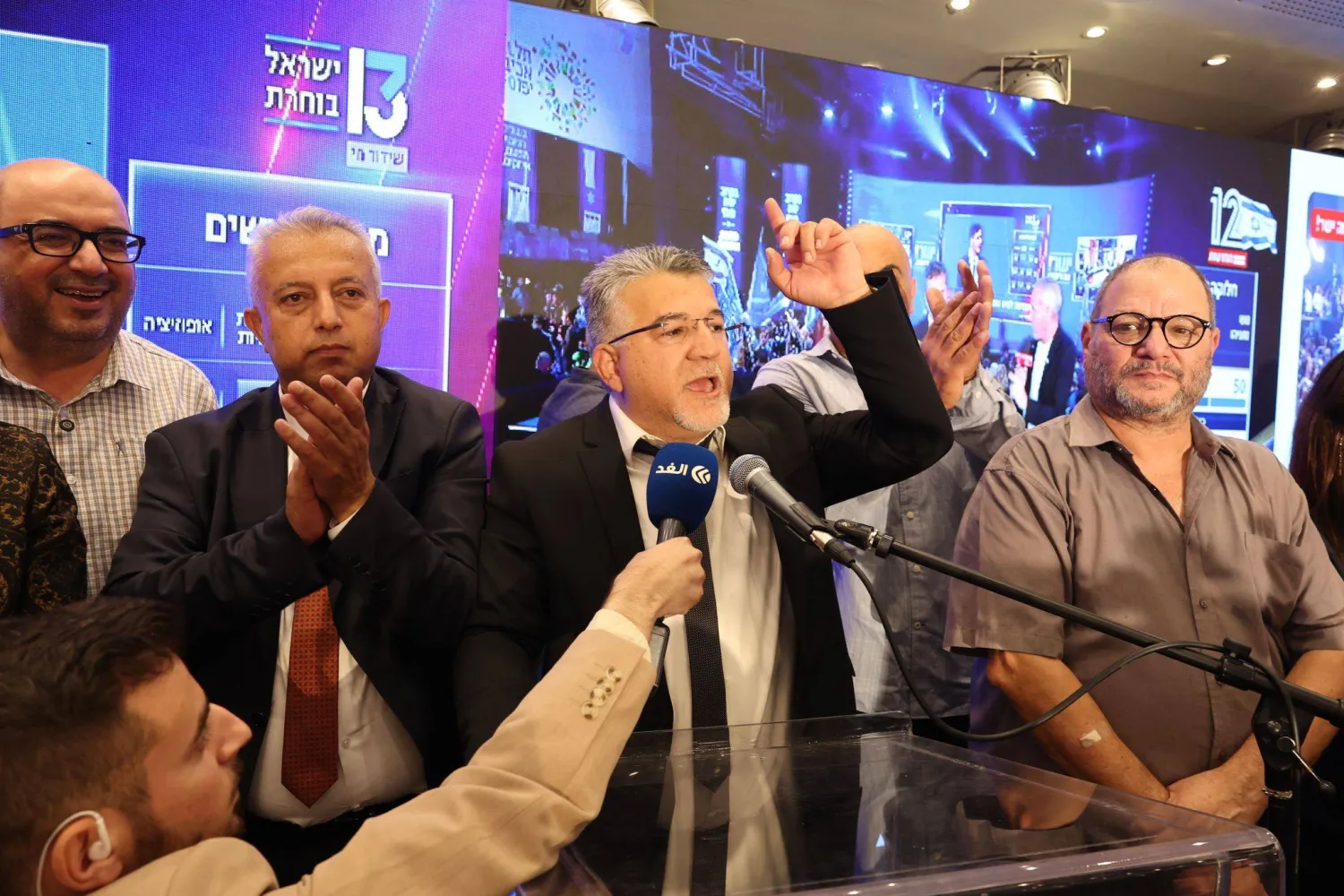
Arab political parties in Israel have signalled their willingness to help replace Prime Minister Benjamin Netanyahu's government after parliamentary elections left neither main political bloc with a projected majority.
Youssef Jabareen, leader of the Joint List, said on 28 October that Arab parties were prepared to use their parliamentary strength to facilitate a change of government following the vote held on 27 October.
Projections based on most votes counted suggested that the Joint List and a separate conservative Islamic party could secure a combined 19 seats in Israel's 120-member Knesset, according to Germany's DPA news agency.
The projected result could give Arab lawmakers considerable influence over the formation of the next government, with neither Netanyahu's governing bloc nor the opposition camp led by former military chief Gadi Eisenkot expected to reach the 61 seats required for a parliamentary majority.
Jabareen described support for Arab parties in the election as historic and accused Netanyahu's government of making life intolerable for Arab citizens of Israel.
"Netanyahu's government and [National Security Minister Itamar] Ben-Gvir have turned the life of every Arab citizen into hell," Jabareen said, according to DPA.
He said the parties intended to use their political influence to advance their priorities and were ready to help remove Netanyahu and his coalition partners from power.
"We are ready to pave the way for replacing the government of Netanyahu, Ben-Gvir and [Finance Minister Bezalel] Smotrich, and removing them from the political scene," he said.
The statements followed an election in which Arab political representation emerged as a potentially important factor in determining the balance of power.
Arab citizens account for approximately one-fifth of Israel's population, although their political representatives have differing positions on participation in governing coalitions.
The projected 19 seats would not automatically translate into support for Eisenkot or another opposition leader. Any arrangement would depend on negotiations among parties and their willingness to cooperate.
Netanyahu has rejected the prospect of a government formed with Arab political support.
In remarks reported separately by Asharq Al-Awsat, he argued that Israel could not have a government dependent on Arab parties.
Israeli left-wing leader Yair Golan has taken a different position, calling for cooperation between opposition parties and Arab lawmakers to remove Netanyahu from office.
The contrasting positions underline a central issue in the post-election negotiations: whether parties opposed to Netanyahu can establish a workable parliamentary majority with Arab political support.
The final distribution of seats and the positions taken by individual parties will determine which coalition arrangements are mathematically possible.