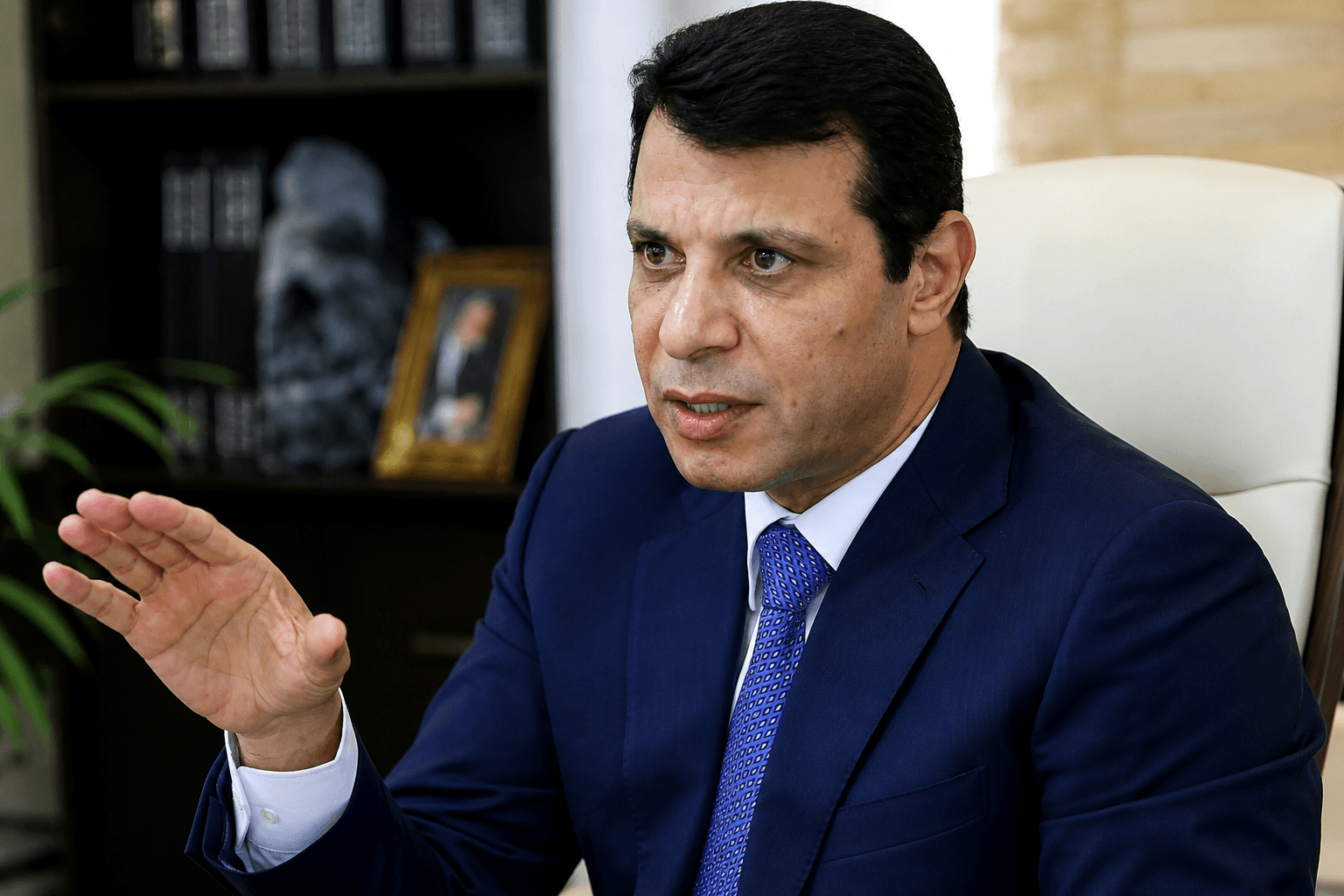
Mohammed Dahlan, the exiled former Fatah security chief in Gaza, has emerged as a prominent intermediary in US-backed efforts to negotiate Hamas’s disarmament and determine how the Strip could be governed after the war.
Dahlan has used longstanding ties with the United Arab Emirates, Egypt, the United States and Israeli officials to establish channels with Hamas and other Palestinian factions. Recent reporting has placed him directly in contacts involving Jared Kushner, a senior adviser to US President Donald Trump, and Hamas officials.
His role became particularly visible in late July and August. According to reporting by Le Monde, Dahlan received a Hamas delegation in Abu Dhabi before travelling to New Alamein in Egypt, where he met Egyptian intelligence chief Hassan Rashad and subsequently acted as an intermediary between Palestinian factions and US envoys.
A separate report published on August 19 said Dahlan met senior Hamas figure Khalil al-Hayya in Cairo as Palestinian factions discussed possible political alliances ahead of legislative elections planned for November. The report said the discussions also involved Jared Kushner.
Dahlan has also publicly acknowledged contacts with Kushner. On August 1, he said Kushner had told him he was working with the Israeli side to halt attacks on Gaza. Dahlan later amended the wording of his post, and Israeli strikes continued. Reuters reported that US officials were contacted for comment and that there was no immediate Israeli response.
The contacts are linked to a US-backed roadmap that calls for Hamas to give up its weapons and for a new Palestinian body to assume responsibility for Gaza. Hamas has said it is prepared to show flexibility but has tied the handover of its weapons to an end to Israeli military operations and an Israeli withdrawal. Israel, meanwhile, has insisted that Hamas must disarm before a withdrawal can take place.
Le Monde reported that the United Arab Emirates had pledged to help settle about $400 million in debts accumulated by Gaza’s administration with private contractors and to compensate Hamas-linked civil servants who could lose their positions during a political transition. The report also said Abu Dhabi estimates its assistance to Gaza since 2023 at about $2 billion.
Dahlan’s influence is not new. Born in Khan Younis, he became a senior Fatah figure after the Oslo period and headed the Palestinian Preventive Security Service in Gaza. He later served as a security affairs minister and was elected to the Palestinian Legislative Council in 2006.
His relationship with Hamas was once defined by open confrontation. His security forces arrested large numbers of Hamas members during the 1990s, while the two movements eventually fought for control of Gaza. Hamas forces drove Fatah's security leadership from the Strip in 2007, forcing Dahlan out of the territory. He later fell out with Palestinian Authority President Mahmoud Abbas and moved to the UAE.
From Abu Dhabi, Dahlan developed close ties with the Emirati leadership and became involved in efforts concerning Gaza, including humanitarian assistance and Palestinian reconciliation. Reuters reported in 2017 that Dahlan had helped secure hundreds of millions of dollars in aid and played a behind-the-scenes role in efforts to improve relations between Hamas and Egypt.
His growing role remains controversial. Dahlan has been promoted by some regional and international actors as a possible figure in a future Gaza arrangement, while critics question his legitimacy among Palestinians and point to his history of confrontation with Hamas and his long absence from the Palestinian territories. A recent New Lines report described him as a major power broker with access to senior Emirati, US and Israeli officials, while citing an Israeli analyst who argued that a Dahlan-led return to Gaza would not reflect Palestinian preferences.
For now, Dahlan is not the formal leader of any proposed Gaza administration. His influence rests instead on his ability to communicate with actors that rarely share the same channels: Hamas, Egypt, the UAE, US officials and figures in Israel.
The latest reports indicate that he is also trying to translate that diplomatic access into political influence, including contacts with Palestinian factions ahead of the planned November elections. The extent of any eventual role for Dahlan in Gaza, however, remains unresolved.


