From Ulm to Filton: The Criminalisation of Palestine Solidarity in Europe
From the Ulm 5 in Germany to Filton 25 in UK, this article examines how European states criminalise Palestine solidarity while protecting the arms industry supplying Israel. It questions the use of terrorism narratives against activists and calls for meaningful resistance.
By Samira Faidi
··12 min read ·
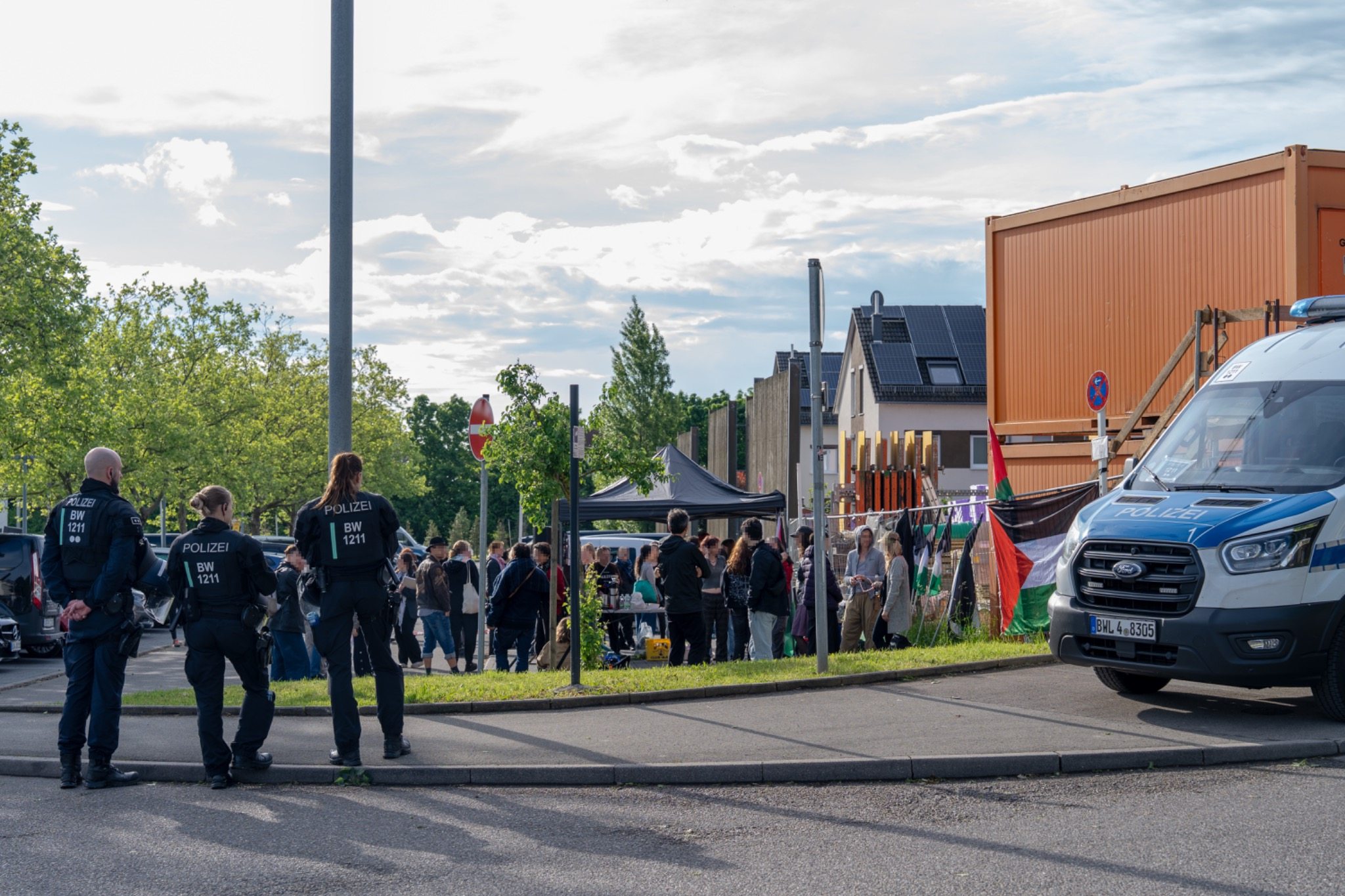
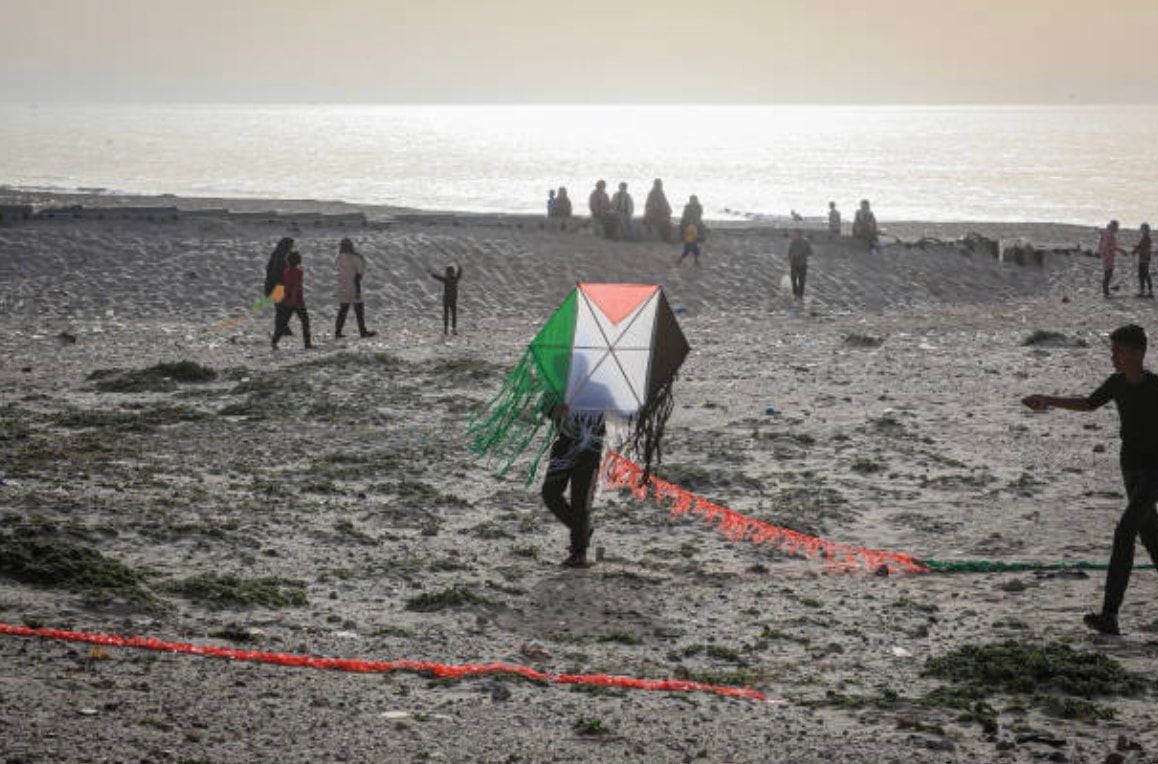
A speaker addressing the solidarity gathering for the Ulm 5 outside the Stuttgart-Stammheim complex, in front of a banner in Palestinian colours. Kredo (Wald statt Asphalt \ Unschärfe Kollektiv)
Solidarity as Spectacle vs Solidarity as Sabotage
Over the past three years, we have seen many different forms of Palestine solidarity. People have demonstrated, donated money, organised themselves and helped families in Gaza or those who managed to escape.
But we have also seen something else.
Organisations and people building supposed aid structures, using intrusive images of Palestinians and presenting themselves as some kind of saviours. We have seen them merge Palestine solidarity into their own branding, collecting money, not only for Gaza, but also for themselves and their "activism".
Yes, we have seen a lot of grifting in the past three years, both from individuals, as well as the aid-industrial-complex.
Heroes of Our Time
But then there are also people and organisations who decided to do something completely different, who were no longer willing to watch weapons being produced and exported from Europe to zionists in Palestine being used to kill Palestinians in Gaza. Instead of building a platform around themselves, they decided to take direct action against the arms industry itself, right here in Europe, where these weapons come to life to destroy life.
These people are the heroes of our time: we should be grateful people like this still exist. Even if they only manage to interrupt this machinery for a short period, their actions bring attention to something many people are not even aware of. That right here, on European soil, weapons are being developed, produced and exported to be used to commit atrocities against Palestinians and carry out the Genocide in Gaza.
So yes, I do think more radical forms of protest are necessary, especially when governments continue to participate in this machinery of illegal warfare. The liberal framework of "nice and polite international law" politics is what is committing The Genocide: we must refuse "respectable" resistance for the sham it is.
This is what activists in Ulm, Germany and Filton, UK decided to do. They knew what could happen to them afterwards. Most of us would never even consider putting our own freedom at risk like this. But these people did.
Ulm and Filton: two actions, same machinery
On 8 September 2025, five Palestine solidarity activists entered the premises of Elbit Systems Deutschland in Ulm, Germany. Elbit Systems is not just the zionist's largest arms manufacturer and supplies military equipment to the IOF, it is the material infrastructure for settler colonialism. It sells weapons, yes, but it also produces the technology of occupation, surveillance and control. This is being ever increasingly exported to western societies to be used there.
The Ulm 5 are accused of destroying equipment worth around one million Euros. They filmed their actions and waited peacefully for the police to arrive. They were arrested at the site. Nobody was physically injured or harmed during the action.In the UK, on 6 August 2024, Palestine Action activists entered another Elbit Systems facility in
Filton, near Bristol. They also destroyed equipment inside the factory, with the intention of disrupting the production and supply of military technology to be used in The Genocide. The action was followed by arrests and criminal proceedings against a larger group of activists, referred to as the Filton 25.
Imperialism at Court
Germany and the UK are different countries, yet both are former European colonial powers with histories of grotesque violence, oppression and genocide. And now we are watching European states treat people who try to disrupt the machinery behind a genocide as terrorists. This is also an expression of imperialist power.
And what makes me especially angry is I am European myself, yes I am an Arab Muslim woman, but I am also European. Of course, growing up in the diaspora, there were times I did not see myself that way, but today, I would find it hypocritical to deny I am European. I live in Europe, I am building my life here, I publish in German and English and much of my political work is about educating people within these very societies.
Being European, however does not mean identifying with Europe's colonial history or defending decisions of European governments. It means recognising I am part of these societies, whether I agree with their politics or not, and that is precisely why I refuse to remain silent about what they are doing.
I see how fascism is becoming normalised, how these people are being given platforms and how their politics are becoming more "acceptable".
The Other as Threat
This is not something that suddenly started with Palestine solidarity. European states have a long history of treating anti-colonial movements as threats to their own security and power. Muslim, Arab and other racialised communities have experienced what it means to be treated as a security problem simply because of who they are, where they come from or what political causes they support.
We see this in the way protests are discussed, with school protests in France described in Germany as “migrant protests”, therefore the political demands of those protesting becomes secondary to their supposed origins. They are no longer simply students protesting, they are "migrants", a categorisation designed to immediately changes how their actions are perceived by white Germans.
Security narratives are now being used against people who take direct action against the arms industry. These are not identical situations, but they reveal something about how political dissent is framed, whose actions are treated as legitimate and who is presented as a threat. What is more concerning is not only the criminalisation of activists, but what this tells us about the direction European states are heading.
In the case of the Ulm 5, all five activists were arrested and imprisoned on the day of their action in September 2025. Five people, who have not yet been convicted of the crimes they are accused of, have already had a year of their freedom each removed for opposing The Genocide and European countries "rights" to profit from it.
The Threat of Stammheim
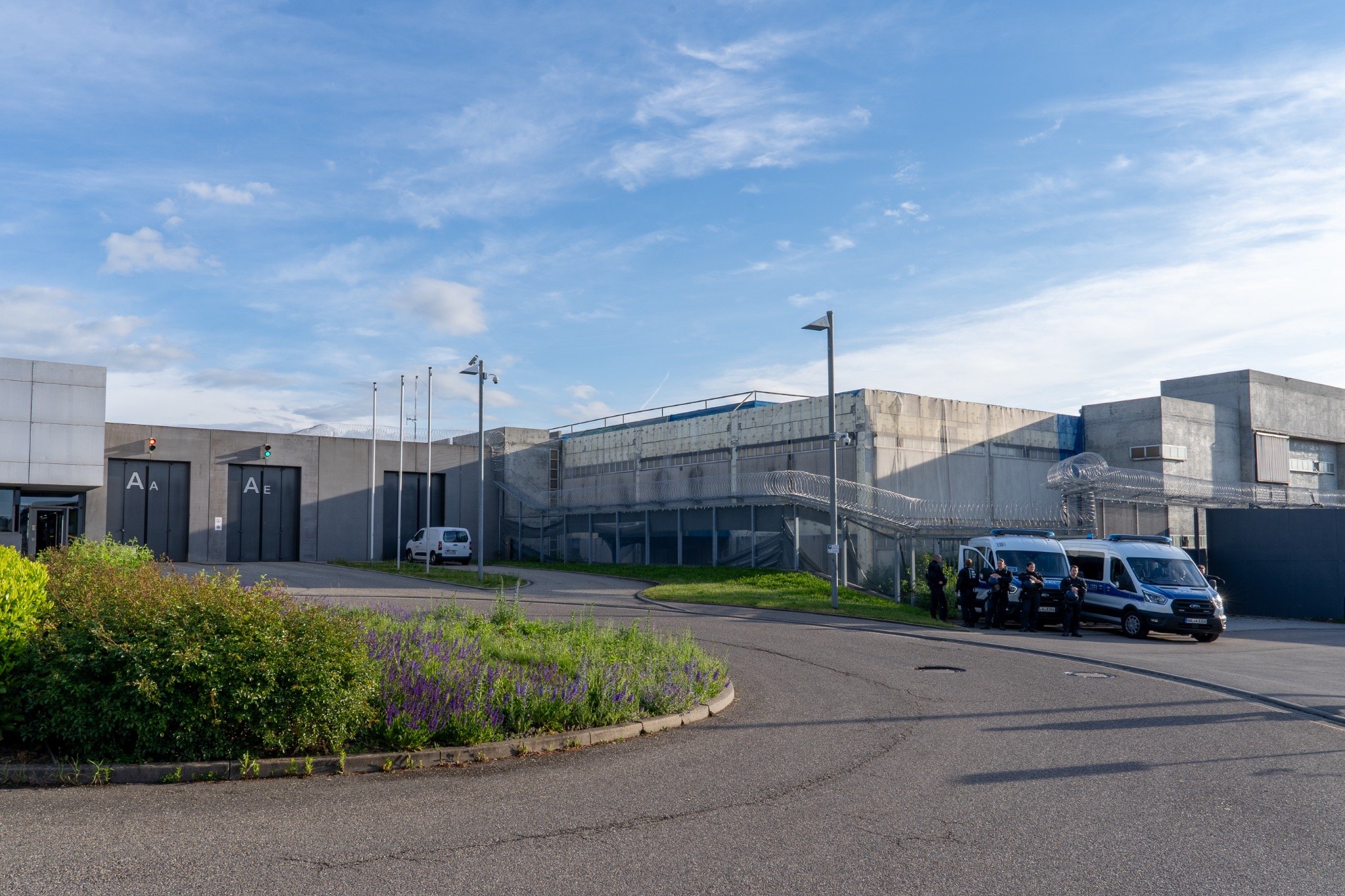
And then there is Stuttgart-Stammheim.
For people outside Germany, the name Stammheim might not mean much, but for Germans, it has a very particular history. In the 1970s, members of the Red Army Faction, known as the RAF, were put on trial there. The RAF was responsible for bombings, kidnappings and killings. And to this day, Stammheim is a name that many Germans connect with terrorism.Germany has chosen this very place to put five Palestine solidarity activists on trial for destroying property belonging to a zionist arms manufacturer fuelling The Genocide. They are also accused of membership in a criminal organisation under Section 129 of the German Criminal Code. They are not charged with terrorism.
The defendants have been brought into court in handcuffs, placed behind security glass and physically separated from their lawyers. Even confidential communication with their own defence has become a matter of controversy. The security restrictions are so extensive, visitors are not even allowed to bring pens and paper into court.
Putting these activists on trial in Stammheim is about sending a message to everyone: if you dare to take direct action against our weapons industry, from which we profit, we will treat you like terrorists to our wallets, you will not just end up in court, we will make you an enemy of the state and use every measure we can against you.
UK's Criminalisation of Resistance
In the UK, the terrorism framing is even more explicit. In July 2025, the British government proscribed Palestine Action under the Terrorism Act 2000. A movement, that has carried out direct action against weapons manufacturers, was placed on the list of prohibited organisations. The ban remains in force, although its legality has been challenged in court. The case is now before the UK Supreme Court.
Some of the Filton activists have already received long prison sentences. In June 2026, Charlotte Head and Leona Kamio were each sentenced to six years in prison, minus 45 days. Fatema Rajwani received five years and eight months, minus 45 days. Samuel Corner received eight years and eight months. Unlike the others, he was also convicted of seriously injuring a police officer. These are years of their lives they are likely to have to spend in prison.
None of the four were convicted of terrorism offences, yet the judge applied a terrorism connection when determining their sentences under Section 69 of the Sentencing Act 2020. All four have appealed their sentences. But the question goes beyond whether these activists received fair trials or proportionate sentences. We also need to question the legal structures that make it possible to criminalise people for taking action against the arms industry while the companies supplying weapons to commit illegal acts, crimes against humanity, continue to operate.
This is all happening despite the fact the International Court of Justice, in January 2024, recognised the right of Palestinians in Gaza to be protected from genocide and ordered Israel to take measures to prevent genocidal acts. An order they have ignored. So how is it people taking action against companies supplying weapons to commit crimes under international law find themselves in court, while those companies continue to profit? What does that tell us about whose interests these legal systems protect? Why should criticism stop at the sentences handed down by these courts, rather than questioning the political and legal structures allowing this to happen at all?
The Costs: time, freedom, uncertainty
The Filton defendants have not all faced the same legal outcomes. Other Filton defendants have spent around 18 months in pre-trial detention. In February 2026, six defendants were acquitted of aggravated burglary. In August, another jury was unable to convict defendants in the second Filton trial. But the proceedings are still continuing, with further trials extending into 2027.
In Germany, the Ulm 5 trial began in April 2026. What was initially expected to be a much shorter trial has now been extended to more than 40 hearing days, with proceedings scheduled into January 2027. Daniel Tatlow-Devally, one of the Ulm defendants, has reportedly spent up to 23 hours a dayinside his cell. His family has described how difficult it has been to organise visits, travel to Germany and deal with the uncertainty of a trial that keeps getting longer.
These people have been sitting in prison for over a year without a verdict. They have lost time with their families, their partners and their friends. What happens if somebody is eventually acquitted: who gives them back the months?
"Terrorists" Opposing Genocide vs Terrorist Murdering Babies
These trials are not just about the people sitting in prison. Everyone else is watching too. Everyone who has been demonstrating, organising and demanding an end to European support for zionists in Palestine. They are watching what happens when people go beyond demonstrations and actually interfere with the highly profitable (for the UK and Germany) arms industry that fuels genocides in Palestine and around the world. The terrorism framing is not a legal technicality, it is a political weapon to shut down rightful resistance to crimes western governments are partaking in.
They see the handcuffs, the security glass, the prison sentences and the years of uncertainty. Euopeans live in countries where weapons are being manufactured and exported to commit The Genocide in Palestine. Europeans have governments politically and militarily supporting zionists while men, women and babies in Gaza are being subjected to mass slaugther and erasure. The weapons industry continues to make money. European governments continue to support it. And the people who try to interrupt it are the ones being treated as a threat.
The moment people enter these factories and destroy equipment to stop their production, suddenly the discussion is about terrorism, criminal organisations and national security. Who are the ones being terrorised? The Palestinians facing annihilation, not the arms manufacturers profitting from crimes.
A Message to Our Communities
We have been forced to watch The Genocide from a distance for years now: we need to start asking ourselves where we are putting our energy and who we are giving our attention to.
We need to stop putting grifters on a pedestal. People who have built platforms in the name of Palestine solidarity, where at some point it is no longer about Palestine but about themselves. About their own image, their own platform, their own money. We need to stop making these individuals the centre of our solidarity.
And instead, we need to remember the people who have given everything. People who have risked their lives, their freedom, their entire existence because they refused to stand by and watch this machinery of death continue. We cannot forget them. We need to go out on the streets for them and support them to make sure they are not left alone.
Especially here in Europe, we need to understand what is happening right in front of us. We are witnessing a political shift that could hardly be more obvious. Fascism is being normalised, militarisation is advancing, and the moment people try to disrupt this war machinery, the moment they interfere with the industries that profit, they are called terrorists and treated like enemies.
Stand with the Ulm 5 and Filton 25
We need to stop allowing ourselves to become numb to the endless stream of news, images and information. We know what is happening. We have known for years. And yet, for too many of us, knowing has become a substitute for doing. That is negligence.
We need to become more radical, and no, that does not mean we all need to break into arms factories.
What it means is we have to be willing to risk something, to give up what is within our power tosacrifice. For some, that might mean risking their freedom, for others, their jobs, friendships, careers, opportunities or their social standing. Not everyone can afford to lose the same things, and I am not asking them to, but we cannot continue pretending solidarity should cost us absolutely nothing.
And yes, that means turning down opportunities, refusing collaborations, walking away from platforms, institutions and organisations denying The Genocide in Gaza or defending it. We cannot claim solidarity with Palestinians while building our careers, expanding our networks or accepting opportunities from organisations denying reality. Some doors should remain closed, even when opening them would benefit us personally.
Boycott. Divest. Organise. Sabotage. Strike. Refuse. Join demonstrations. Build pressure on politicians and institutions. Challenge complicit employers, universities and companies. Refuse to give money, labour or silence to those enabling this violence. Support people facing prosecution for their activism.
There are many ways to act, and not all of them require the same sacrifices of everyone, but doing nothing while continuing to consume one horrific headline after another cannot be one of them. Not in good conscience.
Find out which groups are supporting the Ulm 5 and Filton 25 and get involved. If you live in Germany or UK, show up on court dates, attend hearings, stand outside courthouses. Meet other people organising in solidarity with them, write them letters, send them words of encouragement, let them know they have not been forgotten and there are people out here standing with them.
These people are the heroes of our time.
While you're at it, find out where your nearest arms manufacturer is. You might be surprised how close it is. Organise a protest outside its gates.