
Two people were killed when two firefighting helicopters collided west of Athens as Greece battled multiple wildfires that have stretched emergency services to their operational limits.
The Greek Fire Service said the contracted helicopters collided while fighting a blaze near Psatha, causing one of the aircraft to crash and burst into flames.
Authorities later confirmed that both crew members aboard the crashed helicopter had died. The crew of the second aircraft were rescued alive.
Footage of the incident showed the helicopters making contact in the air before one of them erupted in flames and fell toward the ground. Authorities have not announced the cause of the collision, and an investigation is expected.
The accident occurred in extremely dangerous flying conditions. Wind speeds reached approximately 100 kilometres per hour in some areas, preventing several firefighting aircraft from collecting or dropping water safely.
Prime Minister Kyriakos Mitsotakis warned that Greece was facing “extremely difficult” days as high temperatures, drought and powerful winds continued to fuel the fires.
Mitsotakis said even the dozens of aircraft available to the authorities could not operate safely when winds reached such speeds. He acknowledged that the severity of the weather could overwhelm both human planning and emergency capabilities.
Greece is confronting several active fire fronts after a week of blazes that have burned more than 12,000 hectares of forest and agricultural land.
Around 500 firefighters were deployed near Porto Germeno, approximately 70 kilometres northwest of Athens, where several coastal communities were evacuated as flames approached residential areas.
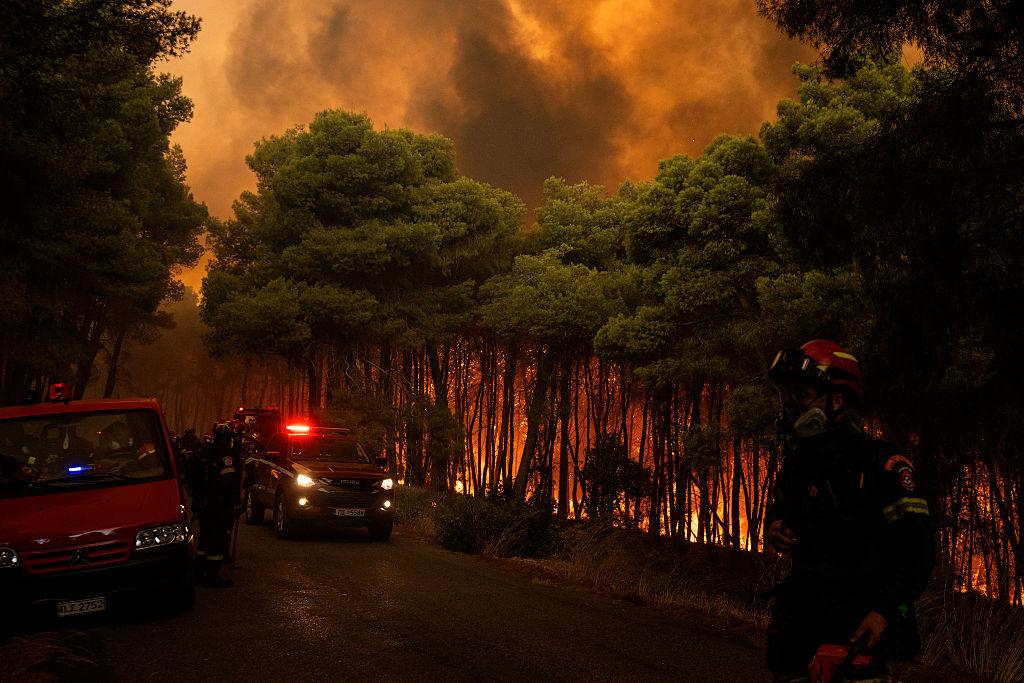
More than 100 homes northwest of the capital have reportedly been damaged or destroyed, forcing residents to flee through thick smoke.
The National Observatory of Athens estimated that separate fires around the Gulf of Corinth had burned more than 6,500 hectares. Researchers warned that the Porto Germeno fire alone may have consumed more than 10,000 hectares, potentially placing it in the category of a megafire.
Experts said the speed of the blaze surprised even experienced emergency teams. Strong winds pushed the flames through forests, agricultural land and coastal communities in a short period.
Other fires were reported in the northern Peloponnese and on the Ionian island of Kefalonia, where authorities issued additional evacuation orders for residents and tourists.
Earlier fires on Crete and Paros burned approximately 6,000 hectares, while firefighters continue to respond to dozens of new outbreaks each day.
The helicopter collision came after three firefighters were killed in the line of duty during the week, including two on Crete and another in the Peloponnese.
Civil protection officials said the Fire Service had reached the limits of its capacity as crews confronted several large blazes and aerial operations were repeatedly disrupted by severe turbulence.
Wildfires occur across the Mediterranean every summer as temperatures rise and vegetation dries. Scientists, however, warn that the climate crisis is making fire seasons longer and more intense while allowing flames to spread faster.
As firefighting and evacuation operations continue, Greece is confronting two simultaneous challenges: containing the expanding fires and protecting the emergency crews operating in increasingly dangerous conditions.
No comments yet. Be the first to share your thoughts.