The United States has crossed a landmark that once seemed almost unimaginable: its federal debt has passed $40 trillion.
The Treasury reported total public debt of $40.047 trillion on August 18, 2026, including $32.266 trillion held by the public and $7.782 trillion in intragovernmental holdings. The debt has more than doubled since Donald Trump first took office in 2017.
Yet the US government continues to borrow, investors continue to buy Treasury securities and the dollar remains the world's dominant reserve currency.
That raises a deceptively simple question: if the world's biggest economy owes more than $40 trillion, why has it not collapsed under the weight of its debt?
Is every American $113,000 in debt?
Not literally.
Dividing the federal debt by the US population produces a figure of roughly $113,000 per person, but this is an accounting calculation rather than an individual liability. Americans do not receive a bill for that amount, nor are they personally responsible for repaying the federal government's debt.
The figure is useful because it illustrates the scale of the government's obligations. The economic consequences are instead felt through taxes, government spending, interest rates, inflation and the services that compete for federal funding.
More borrowing can also place pressure on interest rates, increasing financing costs for households and businesses.
How did the trillions pile up?
Federal debt accumulates when government spending exceeds revenue. The Treasury finances the resulting deficit largely by selling government securities.
The increase has accelerated during wars, recessions and financial emergencies. During the Covid-19 pandemic, for example, the government borrowed heavily to support households, businesses and the wider economy.
But emergencies alone do not explain today's debt.
The US has continued to run large deficits after the worst of those crises passed, with spending on Social Security, Medicare and other programmes rising alongside interest payments. Reuters reported that the July 2026 deficit reached $432 billion, while the first 10 months of the fiscal year had already produced a larger deficit than the whole of fiscal 2025.
The Congressional Budget Office projects a $1.9 trillion federal deficit in fiscal 2026, equal to 5.8% of GDP, compared with an average deficit of 3.8% over the previous 50 years. It projects the deficit reaching $3.1 trillion by 2036.
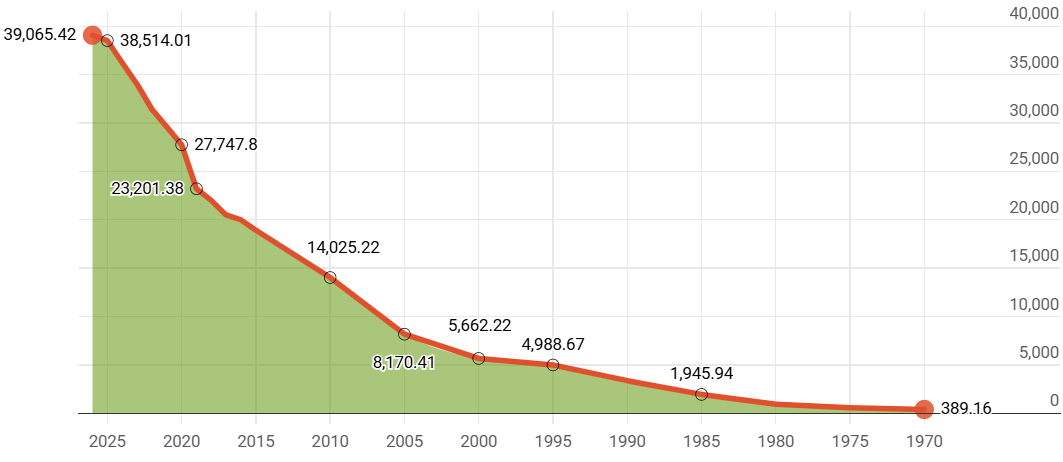
Total US federal debt, 1970–2026
The long-term trajectory explains why the $40 trillion milestone matters.
Federal debt was below $1 trillion until 1981. It reached about $5.8 trillion at the end of fiscal 2001, passed $10 trillion in 2008 and reached $26.9 trillion in 2020.
Since then, it has climbed by more than $13 trillion.
The pandemic accounted for a large part of the acceleration, but the underlying gap between federal revenue and spending has remained. Reuters estimates that roughly one-third of the increase since early 2017 came during the two years of intense borrowing associated with the pandemic response.
Why does America keep borrowing?
The United States borrows because its government spends more than it collects.
That is not automatically a sign of economic failure. Borrowing can allow governments to respond to recessions, finance infrastructure or support the economy during an emergency.
The problem is the persistence of large deficits during periods when the economy is expanding.
The CBO projects that debt held by the public will rise from 101% of GDP in 2026 to 120% in 2036. It says net interest costs will rise from about $1 trillion in 2026 to $2.1 trillion in 2036.
At that point, an increasing share of federal revenue will be needed simply to service existing debt rather than finance new programmes.
The government also does not have to repay the entire $40 trillion at once. Treasury debt is issued with different maturities, from short-term bills to bonds lasting decades. As securities mature, the Treasury can issue new debt to refinance them.
That system works as long as investors remain willing to buy the new securities at sustainable interest rates.
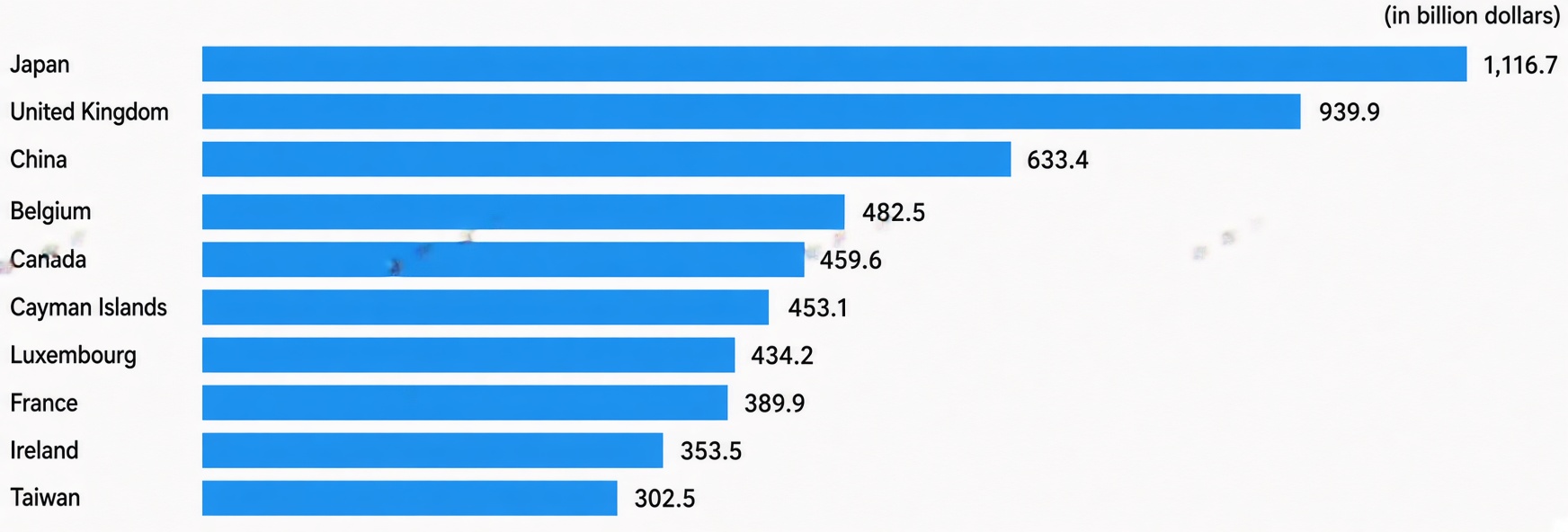
Top 10 foreign holders of US Treasury securities
Foreign investors are important, but they do not own most US government debt.
In June 2026, foreign investors increased their holdings of US long-term securities, with net purchases of $207.1 billion during the month, according to the Treasury Department.
Japan, the United Kingdom and China are among the largest foreign holders of US Treasury securities. But the foreign share is only part of the overall market.
The majority of US government debt is held by investors and institutions within the United States, alongside the Federal Reserve and federal government accounts.
That is why the common description of China as the country that “finances America” is misleading.
China can sell its Treasury holdings, but doing so on a large scale could also push down bond prices and reduce the value of its remaining holdings.
Who owns the debt?
US federal debt is broadly divided into two categories.
The first is debt held by the public, which stood at about $32.3 trillion when total debt crossed $40 trillion. It includes Treasury securities held by individuals, banks, investment funds, pension funds, the Federal Reserve, foreign investors and other entities outside the federal government.
The second is intragovernmental debt, worth about $7.8 trillion at the time. This largely represents federal trust funds and other government accounts holding Treasury securities.
The distinction matters because not all of the debt is money owed to foreign countries. A substantial amount is effectively held within the US federal system.
America's confidence auction
Every time the Treasury sells new securities, investors are effectively deciding how much they are willing to lend to the US government and at what interest rate.
Treasuries are attractive because the market is enormous and highly liquid. Banks can use them as collateral, pension funds can hold them against future obligations and central banks can use them as reserve assets.
The dollar adds another layer of demand.
The IMF reported that the US dollar accounted for 57.13% of global official foreign-exchange reserves in the first quarter of 2026, compared with 20.03% for the euro.
That means governments and financial institutions around the world continue to need dollar-denominated assets, including US Treasury securities.
The dollar's privilege and its limits
The United States has an advantage that many heavily indebted countries do not: it issues the currency in which its debt is denominated.
Washington therefore does not face the same risk as a government that borrows heavily in a foreign currency and can run out of the currency needed to repay its creditors.
But that does not make debt unlimited.
The constraints are inflation, interest costs, economic resources and investor confidence. If the government creates or borrows money faster than the economy can absorb it, inflationary pressure can rise.
And if investors become less confident in the government's fiscal position, they can demand higher yields.
That is already becoming more important as borrowing costs rise. Reuters reported in August that long-term Treasury yields had reached their highest levels in years, while higher Treasury yields were feeding into mortgage, car and commercial borrowing costs.
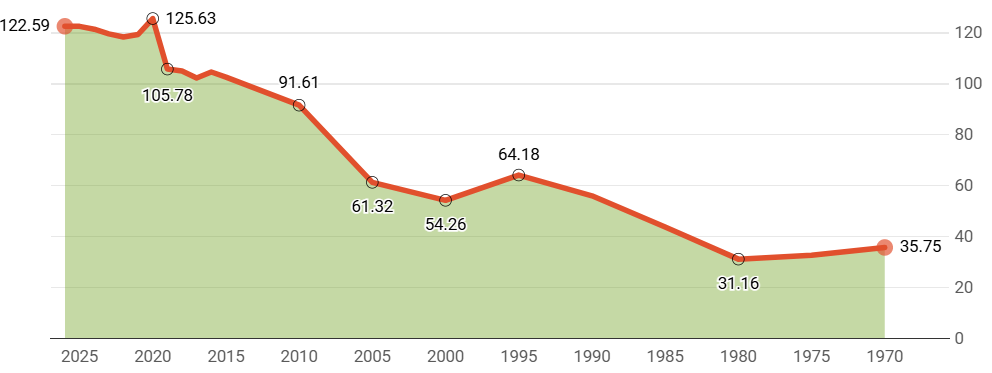
Federal debt as a share of US GDP, 1970–2026
The absolute size of the debt tells only part of the story.
Economists also compare debt with the size of the economy that generates the income and tax revenue used to service it.
According to the CBO, debt held by the public is projected to reach 101% of GDP in 2026 and 120% in 2036. The agency says that would exceed the previous post-Second World War peak of 106% of GDP.
There is no single percentage at which an economy automatically collapses. What matters is whether debt continues rising faster than the government's ability to manage its financing costs.
The test of confidence
The US has another potential pressure point: the statutory debt limit.
The limit was raised to $41.1 trillion in July 2025. It does not authorise new spending; rather, it restricts how much the Treasury can borrow to meet obligations that Congress has already approved.
When the ceiling becomes binding, the Treasury can use temporary measures to delay the point at which it runs out of borrowing capacity. Those measures do not reduce the underlying debt.
Previous confrontations have shown the potential cost. The Government Accountability Office estimated that delays in raising the debt limit in 2011 increased Treasury borrowing costs by about $1.3 billion during that fiscal year.
The larger test is therefore not whether the debt counter reaches another trillion-dollar milestone.
It is whether investors continue to believe that the US government can finance its obligations without requiring sharply higher interest rates.
For now, that confidence remains strong enough to keep the Treasury market functioning and Washington borrowing. But the cost of maintaining that confidence is rising: CBO expects net interest payments alone to double from about $1 trillion in 2026 to $2.1 trillion in 2036


No comments yet. Be the first to share your thoughts.