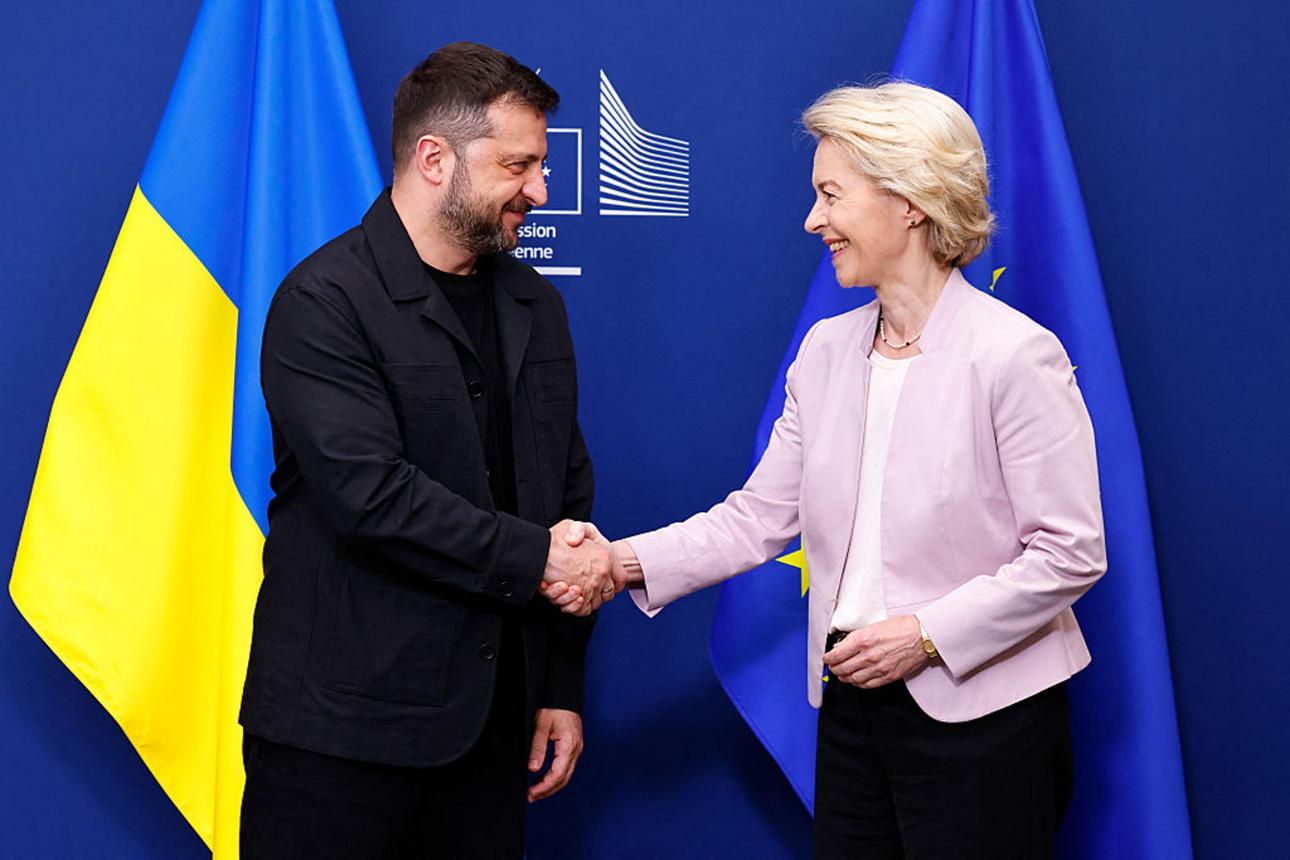
Ukrainian President Volodymyr Zelenskyy said on 21 October that he would support freezing the current front lines as a first step towards ending the war with Russia.
Speaking to Fox News, Zelenskyy said an immediate halt to the fighting could create an opportunity for negotiations, provided a lasting agreement included security guarantees for Ukraine.
He also called for direct talks involving himself, US President Donald Trump and Russian President Vladimir Putin, preferably with European leaders taking part.
"It's important to negotiate trilaterally," Zelenskyy told the broadcaster.
The remarks came as US special envoy Steve Witkoff travelled to St Petersburg for talks with Putin, following discussions with Zelenskyy and European representatives in Oslo on 20 October.
Kyiv has repeatedly insisted that decisions about Ukraine's territory and security must involve its government, particularly as Washington seeks to restart negotiations with Moscow.
Zelenskyy said he remained open to different negotiating formats but opposed any agreement reached without Ukrainian participation.
He described his meeting with Witkoff in Norway as productive and expressed hope that the American envoy would return from Russia with progress towards further negotiations.
The Ukrainian president also welcomed Trump's calls for a ceasefire, saying the immediate priority should be stopping the fighting before addressing longer-term political and territorial questions.
However, he maintained that Ukraine would not accept Russian demands to surrender territory it still controls in the eastern Donbas region.
Russia agrees to resume negotiations
Hours after Zelenskyy's interview, the Kremlin announced that Putin had agreed in principle to resume US-mediated negotiations involving Russia and Ukraine.
Kremlin foreign policy adviser Yuri Ushakov said technical-level discussions could begin on or after 10 November, potentially in Abu Dhabi.
The proposed meetings would focus on security arrangements for Russia and Ukraine after the war.
Witkoff presented Moscow with ideas developed during the Oslo discussions, but Ushakov said some elements of the proposals were unacceptable to Russia.
The two countries remain divided over the conditions for ending the conflict.
Moscow continues to demand full control of the Donetsk region, an exclusion of Ukrainian NATO membership and a comprehensive peace agreement rather than a temporary halt to hostilities.
Earlier US-mediated negotiations failed to resolve these differences, although previous rounds produced limited agreements on prisoner exchanges.
Starshield restrictions remain unresolved
Zelenskyy also addressed tensions with Washington over intelligence sharing and access to satellite communications used by Ukrainian forces.
He thanked the United States for restoring intelligence cooperation following recent disruptions and said he hoped restrictions affecting Starlink and Starshield would soon be removed.
Starshield is a military-focused satellite communications service developed by Elon Musk's company SpaceX. Ukraine relies on the technology for military communications and drone operations.
The Associated Press reported that restrictions introduced in October limited Starshield connectivity on platforms travelling above approximately 160 kilometres per hour, complicating certain Ukrainian drone missions.
Zelenskyy said the military service remained restricted and that he had discussed the issue with US Secretary of State Marco Rubio.
CBS News reported, citing people familiar with the matter, that Musk had decided to restrict Ukraine's use of the network following discussions with US administration officials.
Musk has disputed suggestions that he independently controls military operating restrictions, saying those decisions belong to the US military and ultimately the president.
Rubio, speaking to reporters on 21 October, denied that the Trump administration had directed the restrictions and said the government could not control every decision taken by a private company.
The dispute has complicated relations between Washington and Kyiv at a time when the United States is attempting to bring Ukraine and Russia back to negotiations.
Despite the renewed diplomatic contacts, neither side has agreed to a ceasefire, and no meeting between the three presidents has been scheduled.