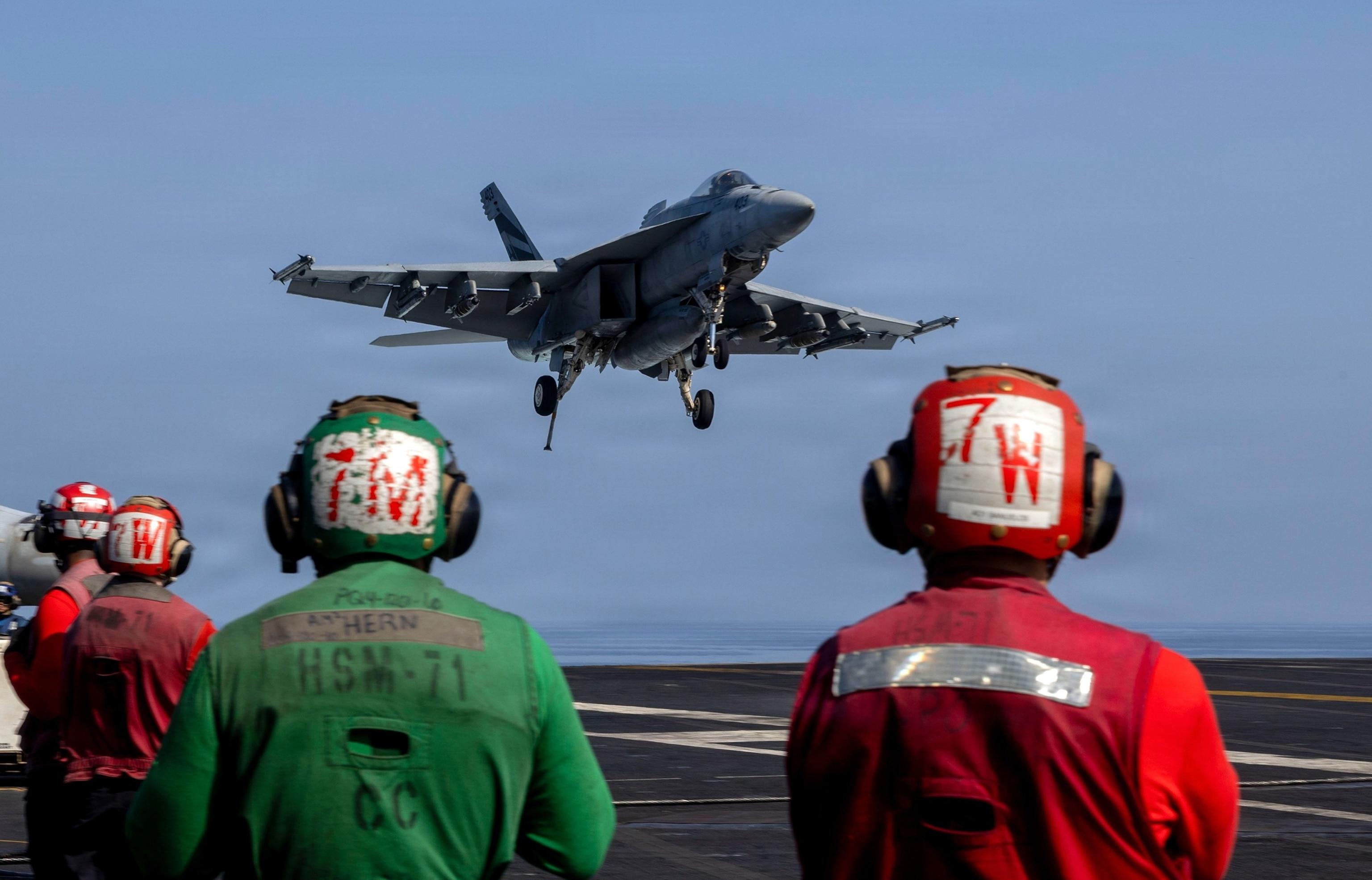
The United States has sharply escalated its confrontation with Iran, striking around 100 targets and attacking two Iranian government tankers as President Donald Trump approved a new “tanker for tanker” policy aimed at deterring attacks on commercial shipping through the Strait of Hormuz.
The latest exchange marked the most intense fighting between Washington and Tehran since July, with US forces hitting Iranian military infrastructure along the country’s southern coast while Iran responded with missiles and drones directed at US facilities in Jordan, Bahrain, Kuwait and Iraq.
US Central Command said its strikes targeted Revolutionary Guard air-defence sites, radar systems, maritime assets, mine-laying capabilities and communications facilities. Iranian media reported explosions in areas including Bandar Abbas, Chabahar, Ahvaz, Asaluyeh and Qeshm Island.
Axios, citing US officials, reported that about 100 targets were struck during the operation and that two Iranian government-owned tankers were also attacked.
The tankers were anchored off Iran’s coast north of the US naval blockade line when American drones fired missiles into their engine rooms, according to Axios.
‘Tanker for tanker’
The attacks represent a significant change in Washington’s approach to Iranian shipping.
A US official told Axios that Trump had approved what was described as a new “tanker for tanker” policy, under which Iranian state tankers could be targeted in retaliation for Iranian attacks on commercial vessels navigating the Strait of Hormuz.
Previous US actions against Iranian tankers had largely been linked to enforcing a naval blockade or sanctions restrictions.
US officials said the new strategy is intended to raise the cost for Tehran whenever the Revolutionary Guard attempts to strike tankers passing through the strait.
The latest US strikes also targeted anti-ship cruise missile launchers, attack drone launchers and Iranian capabilities used to lay naval mines, according to Axios.
Trump said Wednesday that US forces had destroyed new Iranian military equipment around the Strait of Hormuz, including radar and missile systems.
“We took out all of the new equipment that they tried to build along the Strait of Hormuz — some defensive, some offensive,” Trump told reporters at the White House.
He described the assault as “very heavy” and said Washington was prepared to strike again.
Iran strikes back across the region
Iran responded by launching missiles and drones towards what it described as US military installations across the Middle East.
The Revolutionary Guard said it had attacked American facilities in Jordan, Bahrain, Kuwait and Iraq.
US officials told Reuters that there were no casualties in Jordan according to initial assessments, despite Iranian claims that American troops had been killed.
Jordan said 13 ballistic missiles entered its airspace, with 10 intercepted and three falling in remote areas.
Bahrain said Iranian drones had been intercepted and destroyed, while Kuwait reported responding to hostile drone attacks.
Iran also claimed that it had struck US facilities in the Kurdistan region of northern Iraq, but neither Washington nor Iraqi authorities initially confirmed those claims.
Iran’s military leadership warned that further American attacks would bring “heavier, more widespread and devastating responses”.
Civilian casualties reported in Iran
Iranian authorities said the latest wave of US attacks killed 18 people and wounded 108 across the country.
Among the incidents was a reported strike on a wedding gathering in Sirik County, on Iran’s southern coastline near the Strait of Hormuz.
Iran said four people, including a four-year-old child, were killed there and as many as 68 others wounded.
Reuters said it was unable to independently verify the circumstances of the incident.
CENTCOM spokesperson Captain Tim Hawkins said the US military was aware of the reports and insisted that American forces did not deliberately target civilians.
Battle for Hormuz intensifies
At the centre of the confrontation is the Strait of Hormuz, the narrow waterway that carried roughly one-fifth of global oil and liquefied natural gas shipments before the conflict.
Washington says its forces have increasingly regained control of international shipping lanes after months of Iranian attacks, mines and restrictions.
Iran rejects that claim and says it retains the ability to control access through the waterway.
Tehran has added another 11 ships to its blacklist of vessels it says violated Iranian navigation rules, bringing the total to 56. Iran has warned that blacklisted vessels could face detention, confiscation or fines if they attempt to cross without permission.
Actual shipping levels nevertheless remain far below normal.
Ship-tracking data cited by Reuters showed only four commodity vessels crossing Hormuz on Tuesday, compared with a 10-day average of about 13.
US officials offered a much more optimistic assessment, saying around 40 ships moved through the strait during Tuesday’s military operation while American forces intercepted Iranian missiles and drones aimed towards shipping.
An increasingly open-ended conflict
The renewed fighting comes six months after Washington launched Operation Epic Fury against Iran.
The conflict has moved repeatedly between intense military exchanges, partial ceasefires, economic pressure and attempts to restore shipping through Hormuz.
Trump said on Wednesday that the renewed US campaign would not continue for “too long”, but simultaneously warned that Washington could launch another major attack at any time.
Iran, meanwhile, has shown no indication that it intends to abandon its pressure on Gulf shipping or US military installations.
The combination of direct attacks on Iranian tankers, continued missile exchanges and competing claims of control over the Strait of Hormuz marks a further expansion of a conflict that is increasingly centred not only on Iran’s military capabilities, but also on control of the energy routes connecting the Gulf to the global economy.


