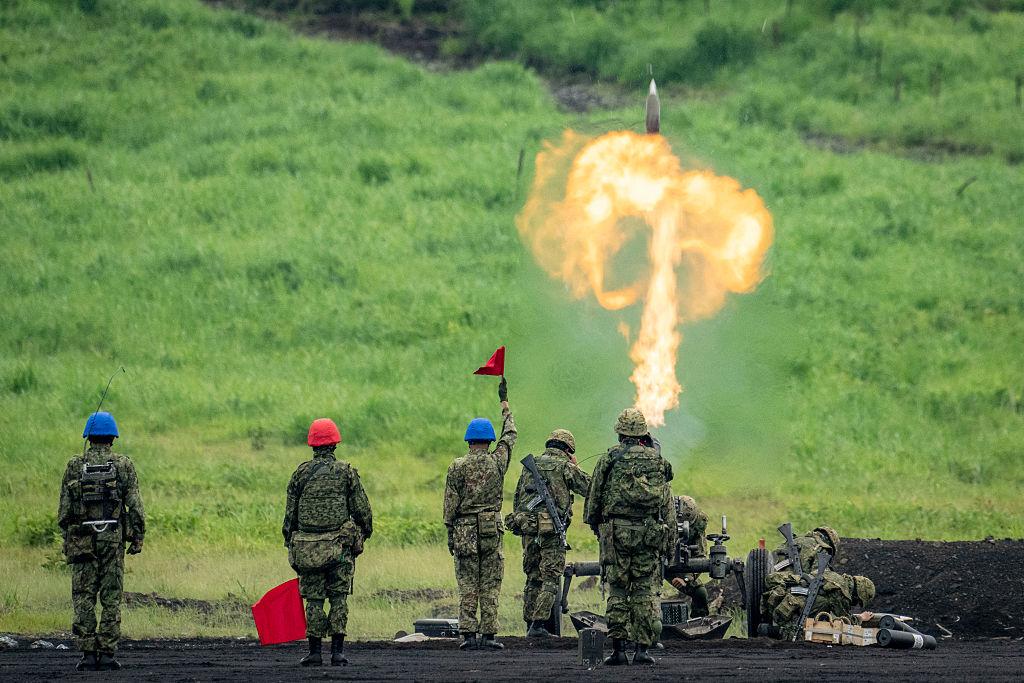
Japan is accelerating one of the most consequential military build-ups of its postwar era, investing in long-range missiles, combat drones and advanced technology as its government warns that the security environment around the country is becoming increasingly severe.
Japan's 2026 defence white paper, released on 4 August, again identifies China's expanding military power as its greatest strategic challenge, while raising concerns about North Korea's nuclear and missile programmes and military activity involving Russia.
The shift marks a further departure from the tightly constrained defence posture Japan adopted after its defeat in the Second World War. Article 9 of the country's constitution renounces war, but successive governments have gradually expanded the role and capabilities of the Self-Defense Forces while maintaining that they remain defensive in nature.
Prime Minister Sanae Takaichi's government is pushing that transformation further as tensions sharpen across East Asia.
China is at the centre of Tokyo's calculations. Beijing has rapidly expanded its naval, missile, nuclear and air capabilities, while Chinese military activity has increased around Japan and in the western Pacific.
Japan protested in July after a Chinese destroyer conducted a live-fire exercise in waters Tokyo considers part of its exclusive economic zone, about 180 kilometres south-west of Okinotori Island. Chinese and Russian vessels participated in the exercises, according to Japanese officials. Beijing said its activities in international waters complied with international law and disputed Japan's position.
Taiwan presents another potential flashpoint.
China claims the democratically governed island as its territory and has not renounced the use of force to bring it under its control. Japan's south-western islands lie close to Taiwan, making a conflict there a direct concern for Japanese military planners.
Takaichi caused a diplomatic rupture with Beijing after saying a Chinese attack on Taiwan could constitute a "survival-threatening situation" for Japan — a legal designation that could allow Tokyo to exercise collective self-defence.
She has not withdrawn the remark. A cross-party group of Japanese lawmakers travelled to Beijing this week seeking to restore dialogue after relations deteriorated.
Japan has already strengthened forces on its south-western islands and begun deploying longer-range cruise missiles as part of preparations for a potential regional conflict.
North Korea presents a different threat. Pyongyang continues to develop nuclear weapons and ballistic missiles capable of striking Japan, while its growing military relationship with Russia has added another dimension to Tokyo's security concerns.
Those tensions have intensified this month.
North Korea condemned Japan's latest defence white paper as a document designed to justify military expansion. Kim Yo Jong, the sister of North Korean leader Kim Jong Un, also threatened "additional military options" after Japan test-fired a US-made Tomahawk cruise missile. North Korea launched a short-range ballistic missile the following day, which some analysts interpreted as a warning to Tokyo.
Japan, South Korea and the United States are now preparing another trilateral exercise focused on responding to North Korea's nuclear and missile capabilities. The Freedom Edge drills are scheduled for September in international waters around South Korea's Jeju Island.
Missiles, drones and AI
Japan's response extends well beyond conventional forces.
The government has been developing stand-off weapons capable of striking targets from greater distances, including upgraded Japanese missiles and US-made Tomahawks. Its 2026 defence plans also place heavy emphasis on unmanned systems.
Combat drones are being developed for coastal defence, while Japanese officials are examining lessons from warfare in Ukraine and the Middle East, where relatively inexpensive unmanned aircraft have transformed battlefield tactics.
Artificial intelligence, cyber defence and information warfare are also becoming central to military planning. Japan's defence ministry has selected domestic drone manufacturers for accelerated development and testing while seeking to involve technology start-ups and commercial suppliers more deeply in weapons production.
The government is increasingly presenting that spending as an economic policy as well as a security requirement.
Its latest white paper argues that a stronger domestic defence industry can support economic growth, encourage technological innovation and reduce reliance on overseas suppliers. Japan is also easing some restrictions on defence exports and pursuing weapons partnerships with other countries.
Tokyo has been working towards defence-related spending equivalent to about 2% of gross domestic product, while its fiscal 2026 defence budget exceeded ¥9 trillion for the first time.
The build-up does not mean Japan has abandoned its postwar constitution or transformed the Self-Defense Forces into a conventional offensive military. But the capabilities available to those forces — and the circumstances in which Tokyo envisages using them — have expanded considerably.
That transformation is unfolding alongside continuing military co-operation with Washington.
US Marines and Japanese forces conducted joint live-fire drills during the Resolute Dragon exercises in Oita Prefecture in June, involving armoured vehicles, drones and other capabilities.
At the same time, questions about Washington's long-term reliability have grown among some US allies after President Donald Trump scaled back or cancelled exercises with South Korea while pursuing renewed diplomacy with North Korean leader Kim Jong Un. Japanese officials and security experts are among those assessing what changes in US policy could mean for regional deterrence.
For Tokyo, that uncertainty is reinforcing a defence transformation already driven by China's military expansion, North Korea's weapons programmes and closer military ties among Beijing, Moscow and Pyongyang.
Japan's 2026 white paper makes clear that its planners no longer regard the country's postwar security environment as something that can be taken for granted.


