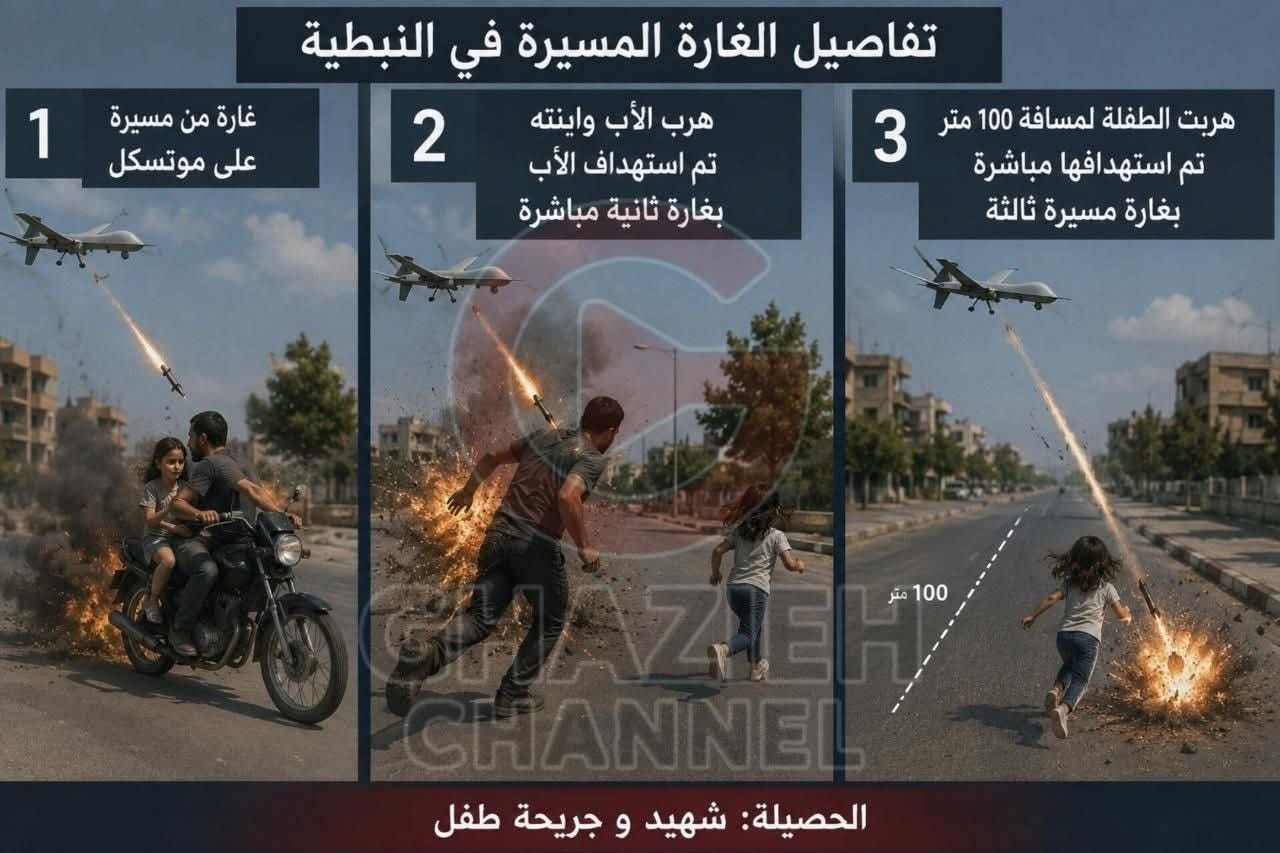
On Saturday morning in southern Lebanon, an Israeli drone fired three missiles at a 12-year-old girl on her father’s motorcycle. The first missile knocked the bike out from under them. The father moved the daughter away from the wreckage. The second missile killed him. The girl ran on foot. The third missile killed her.
The road was in Nabatieh. The school was to her left. It was morning.
The bike is warm under her. Her hands are on her father’s waist. The engine hums up through her thighs. The road is gray. The school is to her left. Morning. Dust. Her sneakers tap against the bike’s metal.
A sound like the sky tearing.
She is on the road. Her father’s hand finds her wrist. He is pulling her up. He is moving her away. Asphalt hot under her hands. The bike is on its side. Smoke. Her father lets go.
The sky tears again.
He is not getting up.
She runs. The road strikes her feet. The noise is everywhere and she cannot hear her own breath. The school is behind her now. She is going somewhere ahead.
The sky tears a third time.
She is on the road.
The man is in a chair in a room.
The screen shows two thermal signatures on a road. One motorcycle. Two persons.
A second man sits at his left. A list of yes-no questions runs on the right monitor. Have you confirmed the target. Have you cleared the area. Have you waited for command.
The mission log shows this is the fourth strike of his shift. He has fired on them twice. At 1134 and 1135. The signatures have separated. The smaller one is moving north along the road at running speed.
He waits. The order comes. He clicks.
His shift ends at 1800. He logs out of the system. He drives home. His daughter is 11. She has a math test tomorrow. They eat dinner. He helps her with her homework. He sleeps. He returns to the chair at 0600.
Three missiles. Three separate decisions. Three separate approvals. Three men signed their names. A legal officer on duty. A commander who gave a green light. The man in the chair who pressed the button.
This is not what failure looks like. This is what success looks like. The rules held. The boxes were checked. It worked exactly the way it was made.
The drone is an Elbit Hermes. Elbit is publicly traded. The morning of the strike, an analyst in Tel Aviv watches the stock open higher and updates the price target.
The missiles are Rafael Spike. In a conference room in Haifa, a sales engineer adds the Lebanon footage to the pitch deck for a foreign delegation arriving next month. “Combat-proven” is the most valuable phrase in the global arms catalog. Rafael has delivered over 40,000 Spike missiles to 41 countries.
In a Lockheed Martin office in Bethesda, a program manager updates the Apache integration slide for a meeting with Army procurement. The U.S. Army has bought 450 Spike missiles. The girl on the road in Nabatieh is part of how Rafael shows the missiles work.
Israeli weapons sales hit record highs in 2024. The war is the demo. The demo is the war.
The stated Israeli war aim in Lebanon is that displaced residents return to northern Israel. They are emptying the south of Lebanon with explosives so houses in the Galilee will sell. House prices in the Galilee are part of the product. Netanyahu’s coalition is part of the product. The next aid bill for Israel in Congress is part of the product.
The same business makes a second thing. It makes the words that let the killing keep going.
The Israeli military has not commented on this strike. By Sunday the Western wire copy will say the strike is “disputed” and that Israel is “investigating.” That sentence is built on purpose. Someone is buying it. The buyer needs the next strike to be possible.
The words make it easy to look away. The words make it sound complicated. The words make it sound like both sides are losing the same kind of life. The words make tomorrow’s strike easy to allow.
There is no live footage of the strike. The image now circulating is rendered by an AI. Where the camera should have been, there is nothing. A made-up image fills the empty place.
The 2,000-pound bombs that drop on apartment buildings are American. Without those bombs Israel could not afford to spend three missiles on a motorcycle. The big American bombs make the small killings possible. When other countries try to stop the strikes at the United Nations, the United States blocks them. When Israel runs low on missiles, the United States sends more. The American president made the ceasefire that is being broken right now.
The shape is built across America.
The F-35s the Israeli Air Force flies are built in Fort Worth, Texas. Their engines come from East Hartford, Connecticut. The Apache helicopters are built in Mesa, Arizona. The Hellfire missiles the Apaches fire are built in Orlando, Florida. The 2,000-pound bomb bodies are forged in Garland, Texas, loaded with explosives in Middletown, Iowa, and turned into precision weapons by kits built in St. Charles, Missouri.
At shift change in any of these parking lots, the workers walk to their cars. Their kids are at home. They are good at their jobs. The parts they built are part of the same trade that ends with three missiles in Nabatieh, with a 12-year-old girl on the road, with the next apartment block in Khan Younis, with the next market in Sanaa.
Whoever lies in the position of the girl on the road is variable. The position is the same.
The girl dies because a man pulls a trigger. The man pulls because his rules let him. His rules were written by the people who built his machine. The machine was built by the business. The business is paid by people across America. The people across America go to work in Fort Worth and East Hartford and Mesa and Orlando and Garland and Middletown and St. Charles.
The same shape shows up at every size because each size makes the next. The girl on the road and the engine on the line are the same shape, seen close and seen far.
Some men pull the trigger and some refuse. Some workers go to the line and some leave. Some journalists write the wire copy and some write what Hala Jaber wrote.
You already know the shape. You have lived inside it longer than its name has been written down in English. The people who build it are good at their jobs.
She had a name. We do not have it yet.
You read this on a phone. The picture was rendered by an AI. The chain runs through where you live. The chain ends in your hands. The chain will keep running. You will know.
No comments yet. Be the first to share your thoughts.