Palm-Sized Blue Octopus Emerges from Deep-Sea Darkness
Scientists have identified a palm-sized blue octopus discovered near the Galápagos Islands as a new deep-sea species, using CT scans to study the rare specimen without dissection.
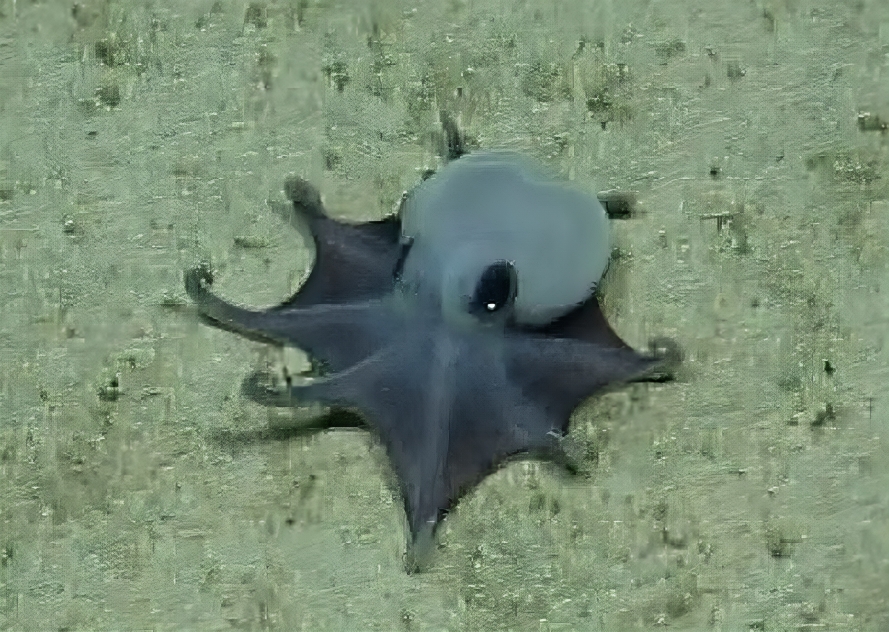
A new study reports that a vivid blue octopus, roughly the size of a human palm, first spotted off the Galápagos Islands in 2015, has been classified as a new species of deep-sea life. Named Microeledone galapagensis, it was discovered during an expedition aboard the research vessel E/V Nautilus.
The crew deployed a remotely operated vehicle to explore the seabed near Darwin Island at the northern edge of the Galápagos archipelago. While navigating around an underwater seamount, the robot’s camera captured the unusual octopus at a depth of about 5,800 feet. The team collected and photographed two similar specimens, but the blue octopus—about the size of a golf ball—stood out among them.
Preserved in alcohol and formalin, the specimen was sent to Chicago’s Field Museum for study. Janet Voight, co-author of the research published in Zootaxa and cited by The Independent, said she immediately recognized it as unique: “I had never seen anything like it before.”
The researchers faced a challenge: they had only one specimen. Voight explained that describing a new octopus species requires examining all its parts, including the mouth, beak, and teeth—tasks that normally demand dissection. To avoid damaging the only sample, the team turned to CT scanning.
Stephanie Smith, another co-author, noted that CT imaging is invaluable for rare type specimens because it is non-destructive. Multiple scans can be combined to create a highly detailed 3D model, revealing internal structures such as the mouth and confirming the octopus as a distinct species.
“These are tiny deep-sea octopuses that almost no one on Earth has ever seen,” Voight said. “I feel lucky to have worked on them. The oceans are vast—if you combined all land on Earth, it wouldn’t cover the Pacific Ocean.”
Researchers emphasized that the discovery highlights how much of the ocean around the Galápagos remains unexplored. Marine biologist Salome Buglass of UCLA added, “Every new species helps us understand these hidden ecosystems better and reminds us why protecting them is vital.”

No comments yet. Be the first to share your thoughts.