Maritime Data Reveals Full Route of Freedom Flotilla Interception Near Gaza
Tracking data shows the complete journey of the Freedom Flotilla from Barcelona to its interception by Israeli forces in international waters near Gaza, highlighting weeks of navigation and escalating tensions.
The Freedom Flotilla set sail from Barcelona, Spain, on April 12 as part of a civilian maritime mission aimed at breaking the naval blockade on Gaza and opening a humanitarian corridor. The first stage included dozens of vessels and hundreds of participants from multiple countries, later joined by additional ships across the Mediterranean.
On April 27, more than 50 vessels departed Augusta port in Sicily, accompanied by support ships such as Greenpeace’s Arctic Sunrise and Open Arms. This marked the transition from the European gathering phase to the eastern Mediterranean approach.
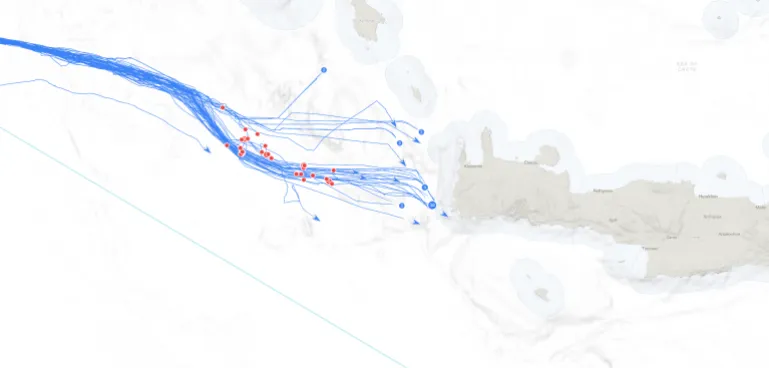
Maritime tracking data revealed key movements, including a split near Crete after several ships faced interception in international waters. By April 30, 22 vessels were classified as “intercepted,” while 36 continued eastward. Around 28 ships clustered west and southwest of Crete, with others further west along the Mediterranean route.
After Crete, Turkey’s Marmaris became a regrouping hub. About 15 vessels arrived there on May 10, while organizers reported over 30 ships leaving Crete for a “technical stop.” Delegates from more than 50 countries met in Marmaris on May 10–11 to plan strategy before resuming the voyage. On May 14, the flotilla launched its final leg toward Gaza.
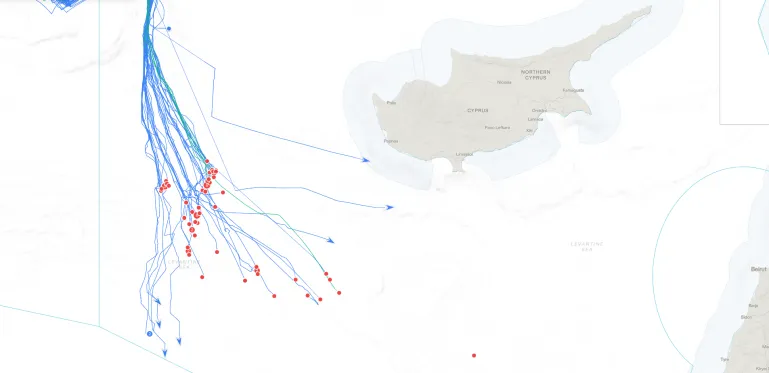
In the hours before the large-scale Israeli interception, tracking data showed the flotilla nearing eastern Cyprus, surrounded by unidentified fast boats and drones. The interception began on May 18 in international waters, about 143 km west of Cyprus and 468 km from Gaza’s coast, after a five-week journey from Barcelona. Israel declared it would not allow any breach of the blockade, calling the flotilla “a provocation serving Hamas.”
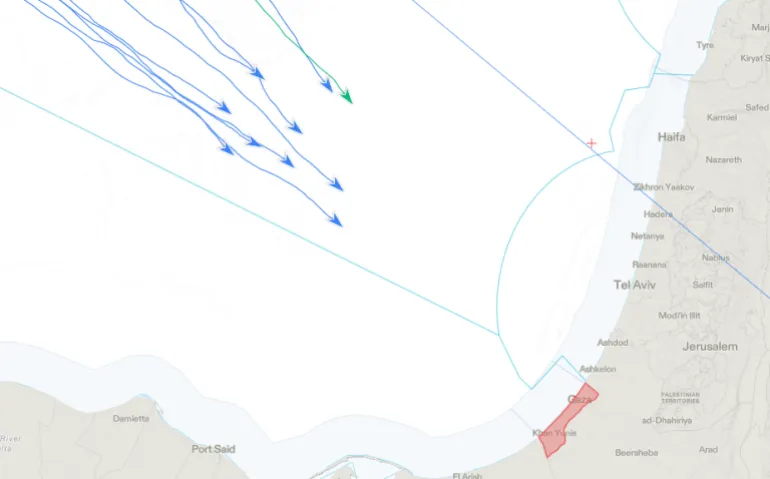
Operations continued through May 18–19, reducing the flotilla from dozens of vessels to fewer than 10. The last ships, including “Aka,” “Beit Hanoun,” and “Ramla” (registered as Sirius), were intercepted within 80–100 nautical miles of Gaza. By May 19, organizers confirmed all 69 vessels had been stopped and 428 activists from over 40 countries detained. They accused Israeli forces of firing on at least two boats, though Israel denied using live ammunition.
The incident drew sharp condemnation. Ten countries—including Turkey, Bangladesh, Brazil, Indonesia, Spain, Colombia, Libya, Maldives, Pakistan, and Jordan—issued a joint statement denouncing Israel’s repeated attacks on the civilian flotilla as violations of international law. They demanded the immediate release of detainees and protection of humanitarian missions. The UN also voiced concern, urging Israel to ensure the activists’ safety and avoid harm.

No comments yet. Be the first to share your thoughts.