
On the dock of an Italian port more than a year ago, two men stood bidding farewell to a single ship called “Madleen,” launched to break the blockade imposed on the Gaza Strip. They exchanged words about a distant dream: what if this lonely symbolic boat turned into dozens of boats? And what if people rode the waves of the Mediterranean carrying the cause of Gaza instead of standing on its shores watching?
Only a few months later, that passing dream turned into the largest popular maritime movement to break the siege on Gaza. Thousands of activists took part in it, but it ended at its final moment with more than 180 activists being handcuffed and lying face down on an Israeli warship in the open sea, and prison doors opened by the Israeli Internal Security Service (Shin Bet) as punishment for two men who once dreamed in Italy: the spokesperson of the Global Sumud Flotilla, Spanish activist of Palestinian origin Sief Abu Keshk, and Brazilian activist Thiago Ávila.
In a long and in-depth interview lasting about an hour and a half, Abu Keshk recounted to Al Jazeera Net the full journey of the Global Sumud Flotilla from idea and formation, to sailing efforts and funding, to what it achieved in international sympathy. He also documented by names, numbers, and dates the moments of violent arrest carried out by the Israeli navy off the Greek coast, as well as the methods of torture and psychological and physical interrogation in the Shin Bet prisons. He explained how this “battle” turned from a mere attempt to deliver aid into a global front to dismantle the siege system and restore attention to the issue of Palestinian prisoners.
“The ultimate goal was never merely to send ships carrying flour and medicine, but rather to declare the invalidity of the Israeli blockade on Gaza imposed since 2007, and to transform the stolen waters of the Mediterranean into a space of popular international confrontation that forces the occupation to retreat, and proves to our people in Gaza that the walls of their isolation have been demolished in the hearts of free people around the world before being demolished on the ground,” Sief Abu Keshk told Al Jazeera Net.
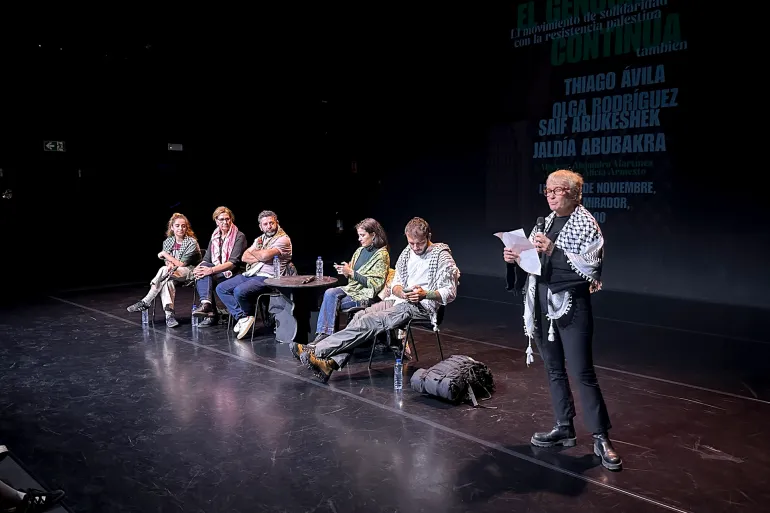
Roots and Popular Expansion
The flotillas to break the Gaza siege began in 2008 through symbolic attempts with one or two ships, the most notable being the “Mavi Marmara” in 2010, which was attacked by Israeli naval forces in international waters off the coast of occupied Palestine. Ten Turkish activists were killed and 56 injured, while the remaining activists were detained, interrogated, and tortured, and the ship and personal belongings were confiscated.
However, the past two years witnessed a major transformation, turning the symbolic idea into a massive popular movement directly challenging the occupation at sea. According to Abu Keshk, in June 2025 the idea crystallized through three parallel movements, independent in organization but unified in media messaging to break the siege:
From the sea: the ship “Madleen,” led by Thiago Ávila and others across the Mediterranean, departing from Italy.
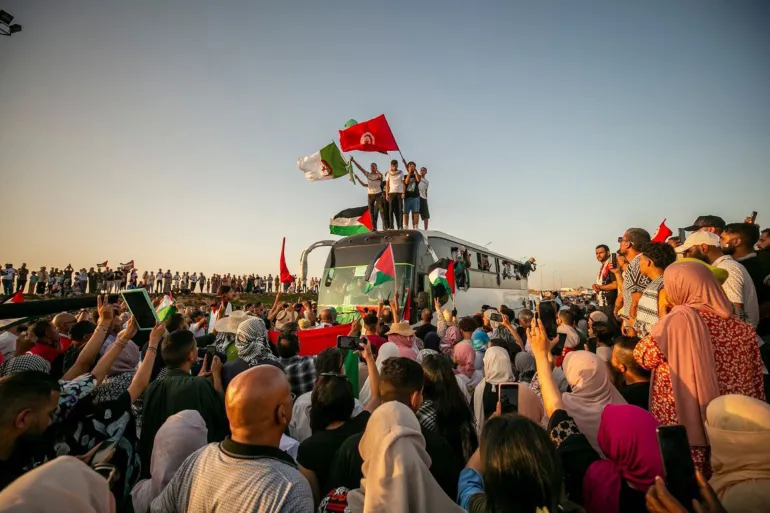
From land: the “Steadfastness Convoy” launched from North African countries.
From air: the “Global March to Gaza,” which included around 4,000 activists from 82 countries traveling by air to Cairo, intending to walk toward the Rafah crossing.
All these movements were intercepted. The Israeli occupation stopped the “Madleen,” while the land convoy was halted by forces in eastern Libya (with 10 members still detained there, according to Abu Keshk). In Cairo, activists were interrogated and deported immediately, preventing them from reaching the crossing.
After these experiences, the organizers decided to merge the independent structures into one alliance, forming the “First Global Sumud Flotilla,” which officially launched from Barcelona on August 31, 2025.
To manage this international movement, a global steering committee was formed, composed of four main blocs:
- Global March for Gaza
- North African Convoy of Steadfastness
- Nusantara Sumud (Asian coalition including Malaysia, Indonesia, Singapore, Maldives, etc.)
-
Activists of the ship Madleen
Funding and Preparing Dozens of Ships
Regarding funding and preparing dozens of ships to sail toward Gaza, Abu Keshk said global popular response was unprecedented. Digital fundraising platforms were opened, receiving full public support:
- More than 89,000 people donated directly online to purchase ships and supplies
- Popular solidarity in more than 55 countries
- Over 100,000 participants registered to join the flotilla
He also pointed to the challenges faced by the 2026 flotilla compared to 2025:
- Media silence: The 2025 flotilla launched during peak Israeli aggression on Gaza, with strong media attention, while 2026 came amid political and media silence after months of ceasefire.
- Security risks: The announcement coincided with US-Israeli tensions with Iran, increasing maritime risks.
- Public exhaustion: Demonstrations dropped from tens of thousands to a few thousand due to long-term mobilization fatigue.
To address this, the coordination committee adopted a strategy:
- Formation of security expert units to monitor Mediterranean risks
- General assemblies at each port (Barcelona, Italy, Turkey) where participants could freely decide to continue or withdraw
- Daily onboard task distribution (cooking, cleaning, night watch, drone monitoring, emergency training)
Israeli Piracy in International Waters
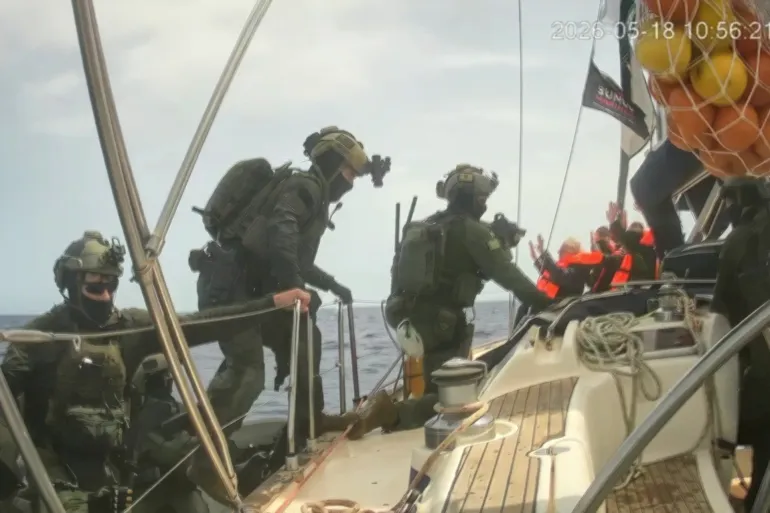
On April 29, 2026, while the flotilla—departed from Barcelona on April 12—was sailing in international waters off Greece, about 700 nautical miles from Palestine, the Israeli naval assault began.
According to Abu Keshk, commandos stormed the ships, ordered everyone to the front, and began calling them one by one. He described:
“They violently stripped my uniform, emptied my pockets, left only my passport, and tightly bound my hands behind my back. We were forced to kneel in humiliating positions.”
Passengers were transferred to a large military vessel, blindfolded, and placed in metal shipping containers converted into floating prisons. Around 181 international activists were detained.
He continued describing beatings, isolation, forced medical checks, and repeated transfers between ships, including being stripped and photographed, and witnessing fellow activist Thiago Ávila under the same conditions.
Inside Shin Bet Prisons
Upon arrival at Ashkelon port, Abu Keshk was transferred to Shin Bet custody and accused of “supporting a hostile entity” and “terror-related charges.”
His wedding ring was confiscated and never returned. He was denied legal counsel initially.
He described psychological pressure, including being offered food repeatedly to break his hunger strike:
“They mixed breakfast, lunch, and dinner in one plate in a cold cell with constant light. They tried to break my strike with lectures on morality and religion, but I continued my hunger and water strike as my last line of resistance.”
Interrogations lasted up to 18 hours daily, focusing on accusations of terrorism and links to Hamas. He said:
“The movement is popular, independent, and fully transparent in funding.”
When interrogation failed, threats shifted to family intimidation.
Military Court Theater
Abu Keshk was transferred multiple times through harsh prisoner transport conditions (“the bus”), appearing in military court sessions where detention was repeatedly extended without evidence disclosure under “secret files.”
He said lawyers had no access to evidence and only provided reassurance.

Deportation Journey
Eventually, he was told deportation was decided. After multiple transfers and a hunger and water strike, he was routed via Athens to Madrid, not his home city Barcelona, without phone or money.
At Athens airport, he reunited with fellow activists and recorded a widely shared video redirecting attention to Palestinian prisoners.
Return to the Waves
Back in Barcelona, he described mixed emotions:
“I felt happiness seeing my family, but also grief for thousands of Palestinian prisoners.”
He immediately resumed activism, traveling again to join preparations for the next wave.
Was the Sumud Flotilla Successful?
Despite interception, Abu Keshk considers it a success:
- Breaking international silence on Gaza
- Building global solidarity movements
- Opening legal cases against Israeli officials
- Listing Israel in UN-related reports on abuses
- Partial delivery of aid debris reaching Gaza, Alexandria, Lebanon, Turkey, and Crete
He concluded that the blockade is not only maritime but global:
“It begins in the US Congress and the European Parliament.”
Strategic Decision
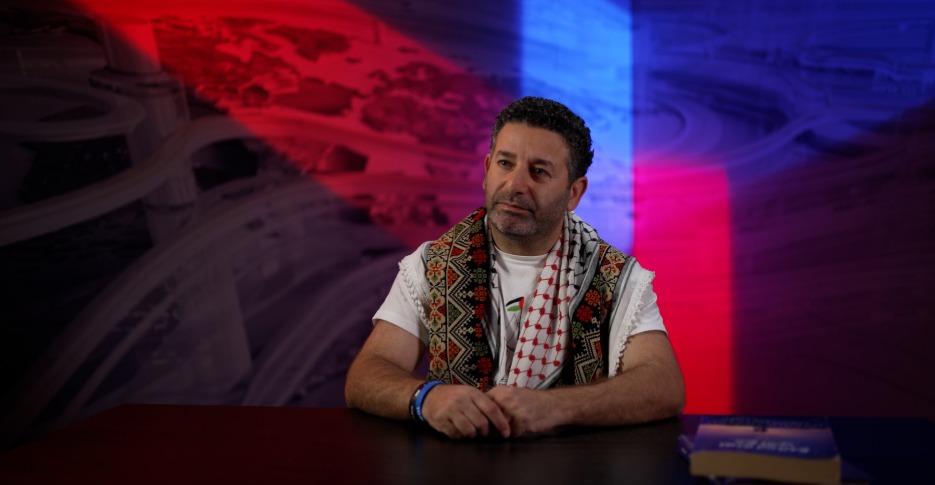
At the end of the interview, Abu Keshk announced transforming the alliance into a permanent movement called the Global Sumud Movement, committed to continuing efforts until the blockade ends and Palestine is fully free.
He ended with a message to Gaza:
“You will never be alone. We will not take a single step back. This is a shared struggle for human dignity, and we will continue until we meet on the free shores of Gaza.”
No comments yet. Be the first to share your thoughts.