
U.S. Assistant Secretary of State for African Affairs Frank Garcia began his first trip to Africa this week since assuming his position, visiting Nigeria, Côte d’Ivoire, and Mali, as the Trump administration seeks to rebuild relations with the Alliance of Sahel States, according to The Africa Report.
The U.S. State Department said in a post on the social media platform X that Garcia’s visit to Nigeria, Côte d’Ivoire, and Mali aims to “advance objectives that protect American security, promote economic prosperity in the United States, and defend U.S. interests.”
The announcement came only hours after what the department described as a “productive” phone call between Garcia and Malian Foreign Minister Abdoulaye Diop, focusing on “shared interests” in the Sahel region.
According to The Africa Report, the tour comes as the Trump administration seeks to restore relations with the Alliance of Sahel States, which includes Mali, Niger, and Burkina Faso, while Russia, a key partner for the bloc, appears “increasingly unable to contain the expansion of jihadist insurgencies,” according to the report.
On July 1, Garcia and Deputy Secretary of State Christopher Landau met with the ambassadors of Sahel Alliance countries in Washington to “reaffirm the United States’ commitment to working with the alliance based on respect for sovereignty and the promotion of mutual interests.”
In Nigeria, Garcia is expected to discuss the next steps in a U.S. military partnership largely focused on protecting Christian communities in the country. According to the White House, major joint operations carried out in May resulted in the killing of Islamic State leader Abu Bilal al-Minuki and around 200 militants.
With Côte d’Ivoire, Washington has been holding discussions for months over the possibility of hosting U.S. air assets after the United States lost its drone base in Niger.
The visit coincides with an expected open briefing by Leonardo Santos Simao, head of the United Nations Office for West Africa and the Sahel, scheduled for July 14, followed by closed consultations on developments in West Africa and the Sahel region.
Trade, Not Aid
The Trump administration has taken its “Trade, Not Aid” initiative to the United Nations, where the U.S. mission is hosting a high-level forum bringing together government officials, companies, and international organizations.
The forum targets countries considered strategically important by Washington and aims to encourage business-friendly reforms in developing economies, while the effects of the closure of the U.S. Agency for International Development (USAID) continue to be felt across Africa and beyond.
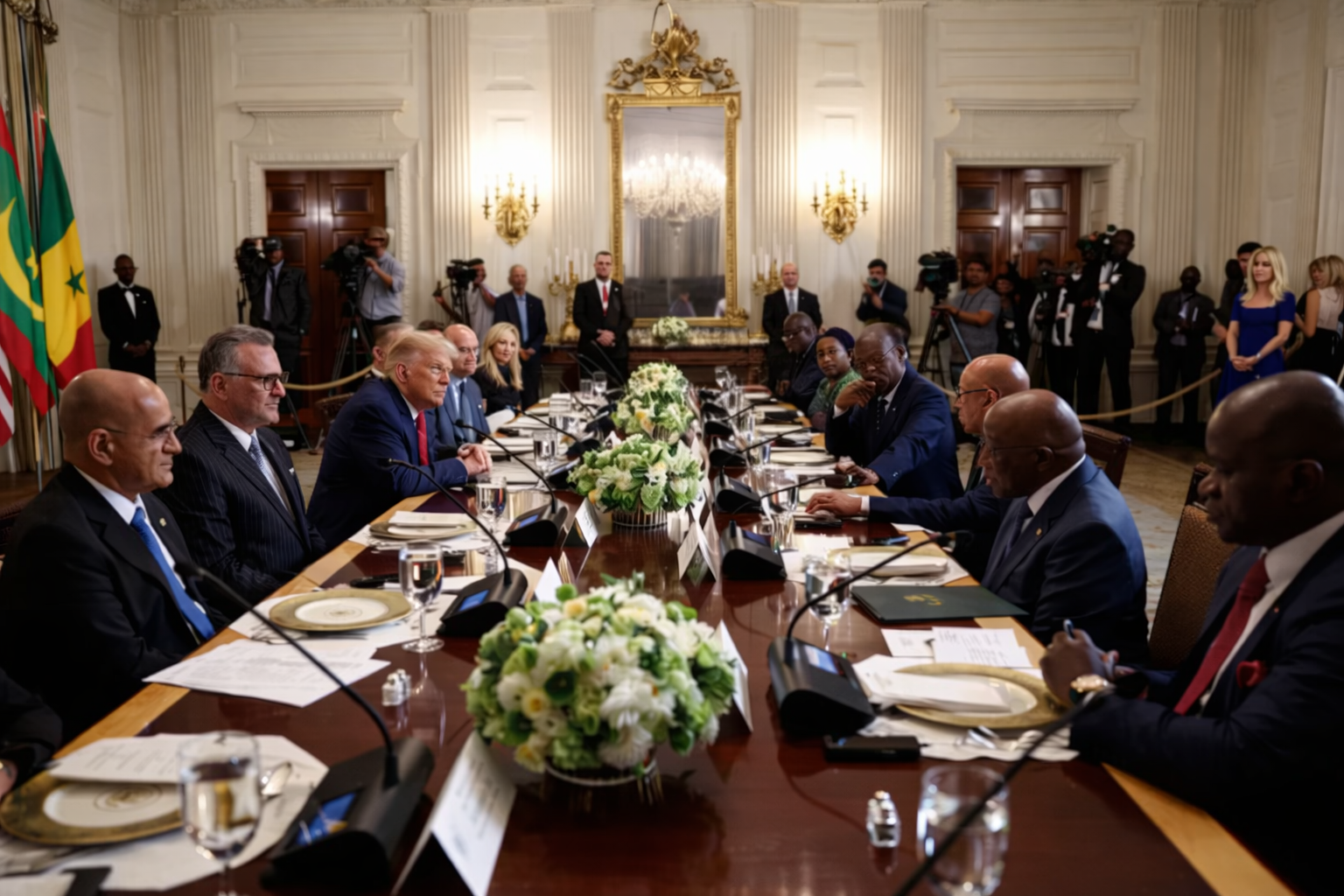
The initiative was launched on April 27 at the New York Stock Exchange, with participation from officials representing Djibouti, Kenya, Lesotho, Morocco, and Uganda.
Tom Hardy, chief executive officer of the U.S. Trade and Development Agency, told The Africa Report that the forum would showcase “how the U.S. government supports its friends, allies, and partners around the world through greater engagement in programs such as the U.S. Trade and Development Agency, the U.S. International Development Finance Corporation, and the Export-Import Bank of the United States.”
He added that “it is no secret that this administration is focused on its partnerships, allies, and friends, and on ensuring that our investments support their long-term sustainable economic growth.”
Meanwhile, Africa’s mineral resources are also receiving significant attention this week, as Democratic Republic of Congo Foreign Minister Thérèse Kayikwamba Wagner is expected to chair an informal expert-level meeting on natural resource governance as part of her country’s presidency of the United Nations Security Council this month.
The meeting will prepare for an event to be chaired by President Félix Tshisekedi next week, focusing on the need for a UN resolution to protect sovereignty over mineral resources.
On July 9, the U.S. Export-Import Bank appointed former Pentagon official Brett Lambert as chief executive officer of Voltco, the entity tasked with leading the Trump administration’s $12 billion critical minerals storage initiative known as “Project Vault.”
No comments yet. Be the first to share your thoughts.