
The consequences of Israel’s war on Gaza extended beyond homes, infrastructure, and essential services, reaching one of the most vital sectors for youth opportunities: technology and entrepreneurship. Once a beacon of hope for thousands of graduates facing unemployment and blockade, the UCAS Tech Incubator of the University College of Applied Sciences was reduced to rubble after Israeli strikes destroyed its headquarters and facilities in Tel al-Hawa, southwest Gaza City.
The losses included a comprehensive ecosystem of training programs, empowerment initiatives, and startups, disrupting the paths of hundreds of young people preparing to enter the digital labor market. UCAS Director Abdullah al-Tahrawi explained that the incubator, founded 13 years ago, aimed to invest in Palestinian youth capacities, foster innovation, and support economic development. Over the years, it empowered more than 500 young men and women, hosted dozens of startups, and supported initiatives in IT, food manufacturing, trade, and creative industries.
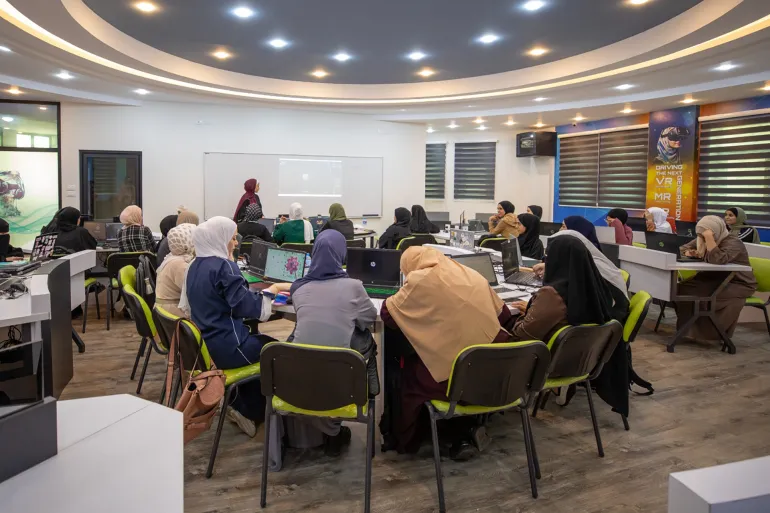
Before the war, UCAS housed 13 specialized facilities, including training halls, conference rooms, media production studios, and co-working spaces. Strategic programs focused on preparing youth for freelance digital work and supporting startups with grants ranging from $5,000 to $10,000. It also launched unique initiatives such as “Insaf,” the first legal incubator for professional development of lawyers.
The war, however, devastated the incubator’s infrastructure, destroying over 20 specialized labs and claiming the lives or freedom of several staff and youth. A field assessment of 100 startups revealed that 80% of their premises were completely destroyed, 15.7% severely damaged, and over 95% of operational environments rendered unusable without reconstruction. Around 23% of workers left Gaza seeking opportunities abroad. “We lost not only infrastructure but also part of our human capital,” al-Tahrawi said, noting that UCAS has begun recovery plans to rebuild innovation and entrepreneurship, targeting over 100 beneficiaries in its first phase.

Gaza’s digital economy had shown remarkable growth before the war, with youth overcoming blockade restrictions through software development, mobile apps, e-commerce, digital education, and online freelancing. Dozens of startups reached Arab and international markets, creating jobs for graduates. Yet widespread destruction of universities, training centers, and incubators, coupled with repeated power and internet outages, halted much of this momentum.
Computer engineer Mohammed al-Safadi, supervisor of the “E-Lancer” project funded by UCAS, stressed that losses extended beyond material damage, disrupting career paths for hundreds of youth. “Labs, computers, and training halls were destroyed, and many projects preparing youth for programming and web development stopped,” he said. The E-Lancer project trains graduates in digital systems and web applications, equipping them for local and international jobs or launching their own ventures. Despite challenges, organizers continue training, convinced that investing in digital talent is key to Gaza’s economic recovery. Student Tharaa al-Sharif described the program as a complete pathway—from technical training to freelancing guidance and career support—helping participants secure real opportunities.
UCAS also extended its role to economic empowerment initiatives for war-affected groups. One such project, “Jawari al-Rasoul,” supports orphaned girls in partnership with Al-Amal Institute for Orphans. Coordinator Amina Hamo explained that participants are trained in fashion design and tailoring to enter the labor market and support their families. “We start from basics to advanced levels, providing equipment and materials free of charge,” she said. Student Bayan al-Sharafa affirmed the project changed her life, giving her professional skills and confidence to produce marketable designs and support her family.
Amid destroyed buildings, shrinking job opportunities, and migration of talent, UCAS strives to preserve Gaza’s innovation ecosystem. For its leaders, reconstruction is not only about rebuilding stone but also rebuilding people—empowering youth with tools to shape their future even under the harshest conditions.
No comments yet. Be the first to share your thoughts.